


Quick Answer
A high pressure ball valve is selected when its pressure-temperature rating, pressure boundary, sealing system, materials, and design match demanding service conditions. A conventional valve may suit lower-duty service, but the actual engineering rating—not the label—should determine selection.
The correct configuration depends on the information in the project datasheet, service conditions, and standards required, which includes the line size, pressure differential, operating temperature, orientation, actuation torque, shut-off, and inspection/testing criteria. These criteria affect the valve configuration, purchasing acceptance, installation planning, and commissioning. In pipeline applications where Class 150-2500 configurations are needed, GOWIN offers floating ball and trunnion ball valves.
What Is a High-Pressure Ball Valve?
High pressure ball valve is not necessarily characterized by being heavier or more expensive. The appropriateness of a high-pressure ball valve depends on the entire pressure boundary and sealing system, which includes the valve body, ball, stem, seats, bolting, end connections, material used, and pressure-temperature ratings.
The ball valve pressure rating must be checked against the actual operating envelope rather than pressure alone. Temperature, fluid properties, corrosion exposure, pressure cycling, shutoff requirements, and the project specification can all affect selection. Pressure surges, differential pressure across the ball, operating cycles, and the consequences of seat or stem leakage should also be considered when defining the required valve configuration.

For pipeline service, API Specification 6D covers requirements for the design, manufacturing, materials, quality control, testing, marking, documentation, and process controls of ball and other pipeline valves.
High-Pressure vs Conventional Ball Valves: Key Differences
The main difference is how the complete valve is engineered for the specified pressure, temperature, size, and service. A standard ball valve can suit moderate service, while more demanding duty may require a different body configuration, ball support, sealing arrangement, materials, or pressure class.
| Selection point | Higher-pressure service | Conventional service | Buyer should verify |
|---|---|---|---|
| Pressure class | Matched to the pressure-temperature envelope | Matched to operating duty | Rated pressure at actual temperature |
| Body and pressure boundary | May use heavier or forged construction, depending on design | Cast or forged construction may be suitable | Material, design standard, and rating |
| Ball support | Trunnion-mounted designs are common in larger or higher-pressure pipeline duties | Floating designs suit many smaller or moderate-pressure duties | Size, differential pressure, and operating torque |
| Sealing | Matched to pressure, temperature, medium, and leakage requirements | Selected for service conditions | Seat material, leakage requirement, and temperature |
| Testing | May require pressure, leakage, NDE, and third-party inspection | Testing remains essential | Test standard, certificates, MTRs, and ITP |
Why Does Valve Design Change as Pressure Increases?
Higher pressure and differential loading increase mechanical and sealing demands on the valve. Engineers therefore examine body strength, ball and stem loading, seat behavior, end connections, materials, actuator torque, and the effect of temperature on allowable pressure.
A trunnion-mounted design supports the ball mechanically and can reduce operating torque in larger pipeline applications. This can matter during actuation and commissioning, but the configuration should still be selected from the valve datasheet and project requirements rather than pressure class alone.
Where Are High-Pressure Ball Valves Typically Used?
Higher-pressure ball valves are commonly specified for isolation duties in oil and gas pipelines, petrochemical systems, power facilities, mining, and other services where pressure, temperature, hazardous media, or large line sizes increase the consequences of leakage or failure.

A high pressure hydraulic ball valve should be selected for the hydraulic system’s pressure, fluid compatibility, connections, and actuation requirements; the term should not be treated as interchangeable with every process ball valve.
When Should You Choose a High-Pressure Ball Valve Instead of a Standard Valve?
Choose a high pressure ball valve when the specified operating envelope, pressure class, temperature, differential pressure, line size, or project requirements call for that level of design. Do not select a higher-rated valve simply because a larger class sounds safer; compatibility with the actual service remains the controlling issue.
For larger pipeline duties, a high pressure trunnion ball valve may be appropriate when the specification requires supported-ball construction, lower operating torque, or a particular pipeline configuration. GOWIN’s Side-Entry Trunnion Ball Valve can be evaluated alongside floating options when the project requires a configuration-based comparison.
Also consider maintenance access and commissioning; a suitable pressure class does not prevent delays caused by poor access, difficult operation, or missing documentation.
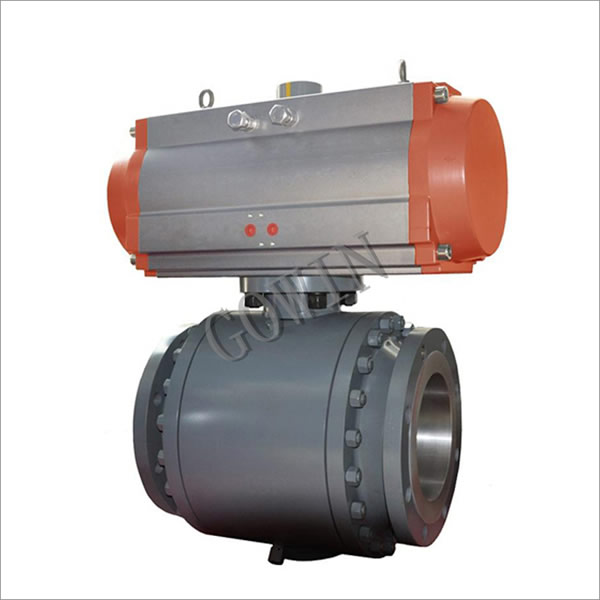
- Nominal diameter: 1/2″-56″ DN15-DN1400
- Pressure: 150LB-2500LB 2.5Mpa-42.0Mpa
- End Connection: RF, RTJ, BW, THR, SW
- Temperature: -196℃-650℃
What Should Buyers Confirm Before Ordering?
Before releasing a purchase order, confirm:
- Design and operating pressure and temperature.
- Fluid type, phase, corrosion conditions, and contamination risk.
- Nominal size, pressure class, and end connection.
- Body, trim, seat, stem, and bolting materials.
- Floating or trunnion configuration where applicable.
- Manual or actuated operation and required torque.
- Leakage, fire-safe, NDE, pressure-testing, and inspection requirements.
- Applicable design and testing standards.
- MTRs, drawings, certificates, test reports, and inspection records.
- Installation space, access, orientation, and commissioning requirements.
One hidden failure point is documentation control. The purchase order, datasheet, approved drawing, inspection plan, and delivered valve should describe the same configuration to prevent reinspection or commissioning delays.
Conclusion
Selecting between conventional and high pressure ball valve designs is a service-matching exercise. Pressure-temperature rating, body and seat design, materials, ball support, testing, and documentation should be evaluated together.
For contractors, the practical workflow is to confirm the engineering datasheet, verify the delivered valve against the purchase specification, complete required inspection and pressure or leakage tests, confirm operation, and document commissioning results. GOWIN’s side-entry trunnion ball valve can be considered when the project requires a supported-ball configuration for demanding pipeline service.
FAQ
1. What makes a ball valve “high pressure”?
There is no single universal pressure value. The designation depends on the valve’s pressure-temperature rating, size, materials, construction, design standard, and intended service.
2. How much PSI can a normal ball valve handle?
There is no single PSI limit. Allowable pressure depends on the specific valve’s pressure class, material, temperature, size, and manufacturer’s rated data.
3. What is structurally different in a high-pressure valve?
Higher-pressure designs may use stronger pressure-boundary components, different ball support, heavier construction, or sealing arrangements suited to greater mechanical and thermal loads. The exact design depends on the application and specification.
4. Does high pressure require forged construction?
No. High pressure does not automatically require a forged body. Cast and forged construction can both be used depending on valve size, material, pressure class, design standard, and manufacturing method.
5. Floating or trunnion—which is better for high pressure?
Neither is automatically better for every application. Selection should consider size, pressure, differential pressure, operating torque, sealing requirements, cycling, and the project specification.


 CHINA
CHINA LIBERIA
 FRANCE
 BARBADOS
 KIRIBATI

