


Quick Answer
High pressure ball valve for oil and gas should be suitable according to pressure class, temperature, line size, medium, materials, sealings, fire-safe, and relevant pipeline standards to the specific application.
The design shall also be appropriate as per torque, end connection, inspection needs, and maintenance. GOWIN offers two configurations: Floating ball and Trunnion ball valves for oil & gas pipeline applications.
What Makes a Ball Valve Suitable for High-Pressure Oil & Gas Service?
High pressure oil and gas isolation application requires pressure holding capability, positive shut-off, compatibility of materials used, no leakage concerns, and reliability in operation. In this scenario, supported ball valve could be chosen depending upon the particular size, pressure, differential pressure, and torque.
Consider the complete valve and not a single component. Valve body, ball, stem material, seats, seals, bolting, end connections, cavity performance, actuator sizing and testing requirements shall all be in compliance with the project datasheet.
Start With Pressure Rating, Temperature and Line Size
Start with the required pressure-temperature envelope, not nominal pressure alone. Pressure class must remain suitable at the specified temperature, while line size affects valve geometry, flow passage, actuator torque, weight, handling, and installation space.
Check maximum operating pressure, design pressure, minimum and maximum temperature, differential pressure during opening and closing, and expected pressure cycling. A high pressure ball valve that meets the nominal class but has an unsuitable material or temperature limit can still be wrong for the service.
| Selection item | Confirm before ordering | Why it matters |
|---|---|---|
| Pressure and temperature | Design and operating limits | Establishes the rating envelope |
| Line size | NPS/DN and bore | Affects flow, weight, torque, and installation |
| Differential pressure | Maximum pressure across closed ball | Influences operation and seat loading |
| Service medium | Gas, crude, condensate, chemicals, or mixed fluids | Determines materials and sealing |
Floating vs Trunnion Ball Valve: Which Design Fits Your Application?
Floating and trunnion-mounted designs use different ball-support arrangements. A floating ball is held primarily by the seats and can suit many process and pipeline duties, while a trunnion-mounted ball is mechanically supported at the top and bottom, which can reduce operating torque as size and differential pressure increase.
Selection should consider valve size, differential pressure, operating frequency, actuator capacity, seat design, and project specifications rather than assuming one construction is universally better. For larger pipeline isolation duties, the supported-ball arrangement may simplify actuator sizing; GOWIN’s side-entry design can be evaluated against the project specification.
Choose the Right Body and Trim Materials for the Media
Material selection should follow fluid composition, temperature, pressure, corrosion mechanism, and required service life. Carbon steel, stainless steel, duplex stainless steel, and corrosion-resistant alloys have different suitability depending on the medium and environment, so material grade and trim details should be stated clearly in the purchase specification.
For example, an NACE ball valve requirement may apply where sour-service conditions create specific material and hardness considerations. A forged steel ball valve may be specified where the project calls for particular pressure-boundary construction; forging is not an automatic requirement for every high-pressure application. An anti static ball valve feature may be required where the specification addresses static-charge control.
Check API, Fire-Safe and Sour-Service Requirements
Standards should match the valve’s actual service and installation. For pipeline applications, API Specification 6D defines requirements for the design, manufacturing, assembly, testing, and documentation of pipeline and piping valves, including ball valves; API currently identifies the 25th edition and subsequent addenda.

A fire safe ball valve should be specified when the project requires fire-tested performance, with the applicable fire-test requirement stated in the datasheet. An API 6D ball valve should likewise be confirmed against the required specification, pressure class, testing, documentation, and inspection plan.
Choose the Right End Connection for the Pipeline
End connections must match the pipeline design, mating flanges or welding requirements, pressure class, bore, and installation method. Flanged connections can simplify removal where maintenance access matters, while welded-end arrangements can reduce bolted joints but require proper welding procedures, alignment, and inspection as applicable.
A common field problem is treating the end connection as a purchasing detail. Confirming flange dimensions, facing, bore, orientation, valve weight, support requirements, and actuator clearance before delivery helps prevent fit-up problems and site modifications.
What Should Be Included in Your Ball Valve RFQ?
A useful RFQ should contain enough information for the configuration to be selected without assumptions. Include:

- Valve size, bore, pressure class, and design pressure.
- Operating and design temperatures.
- Fluid composition, phase, corrosion conditions, and sour-service requirements.
- Body, trim, seat, seal, and bolting materials.
- Floating or trunnion configuration, where applicable.
- End connection type, facing, bore, and dimensions.
- Manual or actuated operation, required torque, and actuator details.
- Leakage, fire-test, pressure-test, NDE, inspection, and certification requirements.
- Applicable standards and project specifications.
- Drawings, material certificates, test reports, and documentation requirements.
One hidden failure point is a mismatch between the RFQ, approved drawing, inspection plan, and delivered valve. Keeping these documents aligned reduces clarification cycles, receiving discrepancies, and commissioning delays.
Conclusion
Choosing a high pressure ball valve for oil and gas connects pressure-temperature limits, materials, ball support, sealing, end connections, standards, testing, and installation requirements. The right selection satisfies the complete project datasheet rather than simply carrying a higher pressure class.
For contractors and buyers, freeze service data first, confirm configuration and documentation, verify the delivered unit against the approved specification, and complete required inspection and commissioning checks before operation. GOWIN’s ball valve range can be used as a reference when evaluating configurations for specified oil and gas pipeline duties.
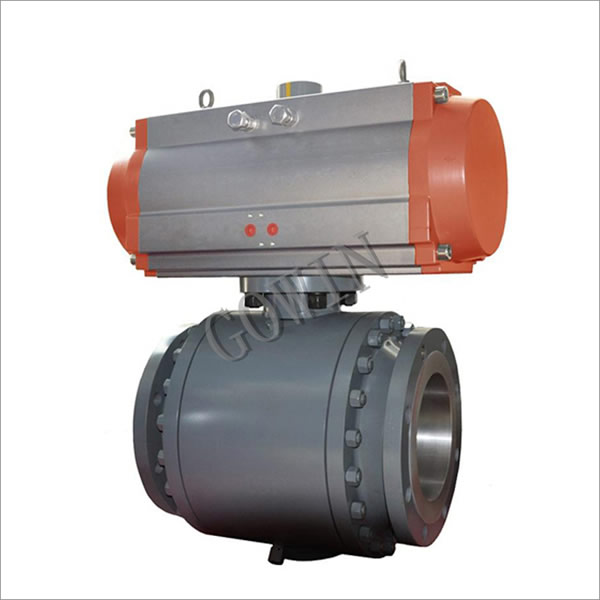
- Nominal diameter: 1/2″-56″ DN15-DN1400
- Pressure: 150LB-2500LB 2.5Mpa-42.0Mpa
- End Connection: RF, RTJ, BW, THR, SW
- Temperature: -196℃-650℃
FAQ
1. What is the most important information when selecting an oil and gas ball valve?
Pressure, temperature, line size, fluid composition, differential pressure, materials, sealing, end connections, applicable standards, and testing requirements should be established before specification.
2. When should a trunnion-mounted design be considered?
It can be considered when valve size, differential pressure, operating torque, cycling, and project requirements make a mechanically supported ball arrangement suitable. Final selection should follow rated data and the approved project specification.
3. What should be checked before installing oil and gas valves?
Verify the valve tag and configuration against the approved drawing, confirm end-connection dimensions and orientation, inspect for shipping damage, check actuator requirements, and complete specified testing and commissioning before service.


 CHINA
CHINA LIBERIA
 FRANCE
 BARBADOS
 KIRIBATI

