


Quick Answer
An automatic shutoff valve (ASV) isolates a pipeline breach within the 30-minute window required by PHMSA’s 2026 Rupture Mitigation Valve (RMV) rule. The mandate applies to new or entirely replaced pipelines 6 inches or larger. Unlike Remote-Control Valves, an ASV uses local pressure sensors for autonomous closure. It does not depend on communication networks. Gowin, a leader in industrial valve solutions, manufactures API 6D-certified gas-over-oil actuated valves designed for this self-powered failsafe.
An automatic shutoff valve is the primary technical solution for isolating a pipeline breach autonomously within the 30-minute window required by federal safety regulations. This hardware satisfies the latest mandates for new and entirely replaced infrastructure by detecting pressure drops locally without the need for human intervention. Failing to install these units correctly can result in significant environmental fines and project handover delays that impact operational margins.
In the field, the most common failure point is the improper calibration of rate-of-drop (ROD) sensors, which often leads to costly nuisance trips during routine pump start-ups. I always advise contractors to verify that their actuator torque is correctly matched to the valve stem to prevent shearing during high-pressure emergency cycles. Implementing this autonomous setup ensures your line remains compliant even if your site-wide communications go down during an emergency event.
What Is an Automatic Shutoff Valve?
In a B2B industrial environment, an ASV functions as a self-contained safety system that triggers a closure based on local sensing of pressure or flow rates. Unlike standard isolation points, these units are equipped with high-performance actuators, usually gas-over-oil or motorized designs, that deliver the necessary torque to seat a ball or gate under full line pressure. The goal is to provide a reliable seal that isolates the affected segment the moment a failure is detected.
For these units to be effective in critical infrastructure, they must be designed in accordance with API 6D and ISO 14313 standards. Because the sensing logic is on-site and self-contained, the valve functions as a failsafe that protects both the environment and the operator’s capital assets. This localized intelligence is why the ASV is widely preferred for remote field applications where network uptime cannot be guaranteed.
PHMSA’s Rupture Mitigation Valve (RMV) Rule Explained — What Changed in 2026
The PHMSA valve rule requires that any newly constructed or “entirely replaced” pipeline 6 inches or larger must be equipped with RMVs capable of full closure within 30 minutes of rupture identification. Under this framework, “entirely replaced” is defined as the replacement of two or more miles of pipe within a five-mile contiguous stretch over 24 months. This forces a shift toward sophisticated automation to minimize the volume of product released during a disaster.
For gas transmission, a rupture mitigation valve is now mandatory in Class 3 and Class 4 locations, as well as Class 2 locations where the potential impact radius (PIR) is greater than 150 feet. Liquid operators face even tighter spacing requirements, with valves needed at maximum intervals of 15 miles for segments affecting high-consequence areas (HCAs). These regulations prioritize automated response over human intervention to prevent prolonged environmental exposure.
ASV vs RCV — Two Paths to RMV Compliance
Choosing between an ASV and a Remote-Control Valve (RCV) usually depends on your site’s existing communication infrastructure and monitoring capabilities. While both satisfy federal mandates, an RCV is linked to a central control room and is entirely dependent on a functional data link to close the rupture valve. In remote regions or during severe weather, a lost satellite or cellular signal renders an RCV useless if it lacks local failsafe logic.
The ASV is often the preferred solution for remote field safety because it operates independently of the data network. By using local pressure sensors to drive the actuator, it ensures the 30-minute closure requirement is met regardless of what is happening at the headquarters. This removes the single point of failure inherent in telemetry-dependent systems.
| Feature | Automatic Shutoff Valve (ASV) | Remote-Control Valve (RCV) |
|---|---|---|
| Trigger Source | Local pressure/flow sensors | Remote SCADA/Human command |
| Operational Autonomy | Fully autonomous | Depends on communication network |
| Response Reliability | Highest for remote segments | Best for staffed central hubs |
| Compliance Method | Meets 30-minute RMV requirement | Meets 30-minute RMV requirement |
| Recommended Use | Remote transmission and gathering pipelines | Sites with reliable communications and continuous monitoring |
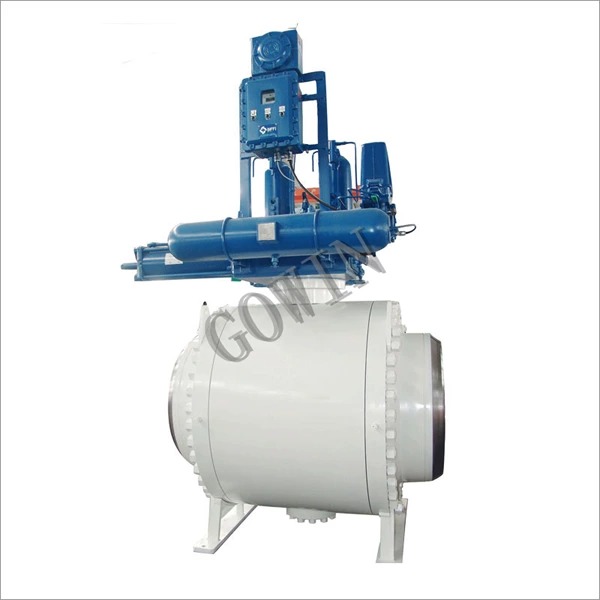
- Nominal diameter: 1/2″-60″ DN15-DN2000
- Pressure: 150LB-2500LB 0.6Mpa-42.0Mpa
- End Connection: RF, RTJ, BW, THR, SW
- Temperature: -196℃-650℃
What to Look for When Specifying an ASV

When you are specifying an automatic shutoff valve for heavy-duty service, the first priority is verifying the material traceability of the forge. For high-pressure service, you need forged steel bodies that meet ASME B16.34 and API 6D standards to avoid structural failure under load. Always demand an EN 10204 3.1 material certificate to ensure the alloy actually matches the spec sheet, as this is vital for clearing international customs.
Furthermore, project engineers must verify shutoff performance in accordance with API 598 testing requirements. This ensures that once the valve is triggered, it provides the isolation required to halt the flow of hazardous media. Every unit should also undergo hydrostatic shell testing in accordance with applicable API 6D and API 598 testing requirements to ensure zero porosity in the valve body.
How Gowin’s Gas-Over-Oil Actuated Valves Support Rupture Mitigation

Gowin brings over 16 years of manufacturing expertise to the energy sector, producing API 6D-certified flow solutions that handle the most demanding pipeline environments. Our gas-over-oil actuated valves are specifically designed for a high-performance automatic shutoff valve setup because they use the pipeline’s own pressure to drive the actuator. This creates a self-powered failsafe that works in total isolation, making it ideal for remote RMV sites.
Every valve we manufacture undergoes rigorous in-house Factory Acceptance Testing (FAT) to ensure it meets the 30-minute closure goal. We provide the full documentation sets—including MTRs, leakage reports, and fire-safety certificates—that you need to pass site safety inspections without delays. Our commitment to precision ensures that when you drop a Gowin valve into your infrastructure, it meets every federal mandate from the first day of commissioning.
Conclusion
The selection of a certified automatic shutoff valve is the most effective way for operators to bridge the gap between strict federal mandates and field-proven reliability. By prioritizing local autonomy, robust forged materials, and documented pressure integrity, you can protect your assets from the catastrophic fallout of a pipeline breach. For engineers seeking a partner that understands the technical rigors of compliance and long-term performance, explore our full range of Gowin Ball Valves to secure your next project.
FAQ
What is the maximum closure time allowed for a rupture mitigation valve?
Under PHMSA regulations, an RMV must be fully closed within 30 minutes of a rupture being identified by the system.
Why do ASVs sometimes trigger during normal operations?
This is typically a “nuisance trip” caused by setting the rate-of-drop sensors too close to normal flow fluctuations or pressure surges during pump starts.
Does the RMV rule apply to all existing pipelines?
No, the rule is primarily triggered by new construction or projects where two or more miles of pipe are “entirely replaced” within a five-mile stretch.





 CHINA
CHINA LIBERIA
 FRANCE
 BARBADOS
 KIRIBATI

