


The key difference in gauge valve vs needle valve selection is function: one isolates and protects instruments, while the other focuses on precise flow control.
If you work with pressure measurement loops, choosing the right valve directly affects instrument accuracy and safety.
This guide focuses on the following, so you can make the right decision:
- Application
- Protection, and
- System design.
Understanding the Role of Each Valve
Before comparing details, you need to understand how each valve works in a measurement loop.
A needle valve controls flow by moving a tapered stem into a seat. It allows fine adjustment and gradual pressure changes.
A gauge valve is installed between the process line and the pressure instrument. Its main purpose is isolation and protection, not flow regulation.
In practice, an instrument needle valve can serve as both a shut-off and control component depending on system design.

Difference 1: Primary Function in the System
The first difference between gauge valve vs needle valve applications is purpose.
Needle Valve Function
A needle valve is designed for:
- Precise flow adjustment
- Gradual pressure equalization
- Controlled venting or draining
- Throttling small flow rates
This makes it suitable for calibration lines, sampling systems, and controlled gas flow.
Gauge Valve Function
A gauge valve is primarily used for:
- Isolating a pressure gauge or transmitter
- Protecting instruments from pressure spikes
- Allowing safe maintenance removal
- Blocking full line pressure during shutdown
A pressure gauge needle valve often acts as a protective barrier between process pressure and delicate instruments.
Difference 2: Shut-Off vs Pressure Relief Capabilities
Many articles fail to clearly explain this difference.
A shut-off function means stopping the flow completely. An isolation needle valve performs this task by sealing the process line.
Pressure relief, however, is different. It allows controlled release of trapped pressure to prevent damage.
Gauge shut-off needle valves focus on blocking and isolating pressure. They do not automatically relieve excess pressure unless integrated into a manifold with a vent or bleed capability.
This distinction matters when protecting transmitters from sudden pressure surges.
Difference 3: Installation Location in the Loop
Location determines how the valve interacts with pressure instruments.
A standard needle valve may be installed in:
- Sampling lines
- Calibration systems
- Low-flow gas circuits
- Bypass piping
A gauge valve is installed directly upstream of a pressure gauge or transmitter.
In more advanced setups, a needle valve manifold replaces a single isolation valve. It combines block, equalizing, and vent functions in one compact unit.
This is where system protection becomes more sophisticated.
Difference 4: Instrument Protection Capability
This is where the comparison becomes practical.
Pressure transmitters and gauges are sensitive devices. Sudden pressure spikes can damage sensing elements or reduce calibration accuracy.
Gowin valve manifolds are designed to protect precision transmitters under high-pressure fluctuations. By controlling equalization and venting, they reduce shock loading.
The Gowin J23 and J29 series needle valves play a central role in pressure measurement loops.
These valves provide controlled shut-off and stable isolation.
Unlike basic valves discussed in many competitor articles, properly engineered manifolds improve instrument lifespan and reduce recalibration frequency.
Difference 5: Flow Control Precision
Precision control is the core strength of a needle valve.
Its tapered stem design allows gradual adjustment. This is ideal when you need smooth pressure changes during calibration or startup.
Gauge valves are not primarily used for fine throttling. Their design focuses on isolation reliability rather than micro-adjustment.
If your goal is precise regulation, an instrument needle valve is the better option. If your goal is instrument safety, a gauge configuration is more suitable.
Gauge Valve vs Needle Valve in Manifold Systems
Modern pressure systems often use multi-valve manifolds.
A needle valve manifold may include:
- Two block valves
- One equalizing valve
- One vent or bleed valve
This arrangement allows safe transmitter installation, calibration, and removal without process shutdown.
In these systems, the distinction between gauge valve vs needle valve selection becomes integrated into a complete protection strategy.
Many top-ranking articles stop at single-valve comparisons. They rarely discuss how manifold design enhances both safety and maintenance efficiency.
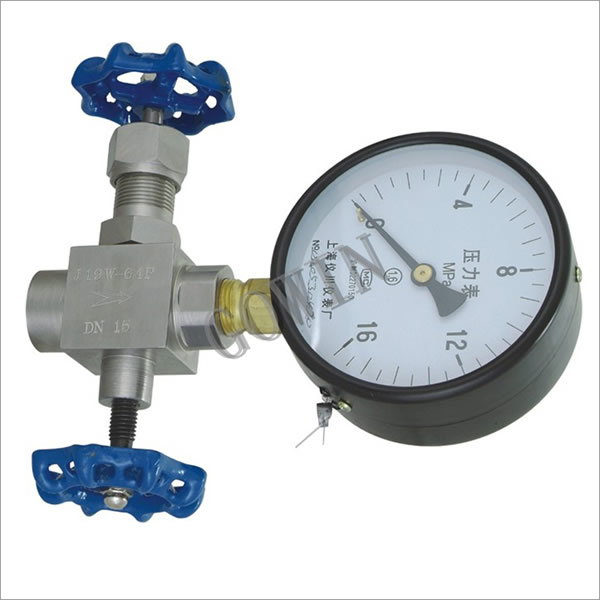
- Nominal diameter: 1/8″-1″ DN6-DN25
- Pressure: 150LB-2500LB 0.6Mpa-42.0Mpa
- End Connection: RF, RTJ, BW, THR, SW
- Temperature: -196℃-650℃
Quick Comparison Table
| Parameter | Gauge Valve | Needle Valve |
| Primary Purpose | Instrument isolation | Precise flow control |
| Flow Adjustment | Limited | High precision |
| Instrument Protection | High | Moderate |
| Typical Location | Upstream of the gauge | Control or sampling line |
| Used in Manifolds | Yes | Yes |
This summary helps you evaluate system requirements quickly.
When Should You Choose Each Valve?
Choose a gauge valve when:
- You need to isolate a pressure gauge
- You want to protect a transmitter from surges
- Maintenance access must be safe and simple
Choose a needle valve when:
- You require an accurate flow adjustment
- You need gradual pressure equalization
- You are working in calibration or sampling systems
In many industrial installations, both valves are used together to balance protection and control.
Final Thoughts
Understanding gauge valve vs needle valve differences helps you protect instruments and maintain system accuracy. A gauge configuration focuses on isolation and safety, while a needle valve provides precise control.
When integrated into a needle valve manifold, especially with Gowin J23 and J29 series designs, these components safeguard pressure transmitters from high-pressure fluctuations and extend instrument life.
Clear knowledge of shut-off, isolation needle valve function, and protection strategy ensures safer and more reliable pressure measurement systems.


 CHINA
CHINA LIBERIA
 FRANCE
 BARBADOS
 KIRIBATI

