


High-pressure needle valves used in hydrogen systems must resist embrittlement, prevent leakage, and maintain strength under extreme pressure. Hydrogen service leaves little room for design weakness.
Hydrogen energy projects, refueling stations, and corrosive processing plants depend on precise flow control.
This guide explains how to evaluate the following aspects for hydrogen applications:
- Materials
- Sealing design
- Thermal stability, and
- Pressure performance.
Why Hydrogen Fluid Systems Demand Specialized Valve Design
Hydrogen behaves differently from most industrial gases. Its small molecules move easily through microscopic gaps and weak material boundaries.
Hydrogen service typically involves:
- Very high operating pressure
- Rapid pressure cycling
- Exposure to hydrogen sulfide in some mixed streams
- High-temperature reforming or cryogenic storage
At elevated pressure, hydrogen can cause embrittlement in susceptible metals. Over time, this reduces ductility and increases cracking risk.
Pressure Ratings and Structural Integrity
Hydrogen refueling stations commonly operate above 6,000 psi. Industrial compression systems may run even higher.
High-pressure needle valves must be engineered for sustained stress, not just short-term bursts.
Key structural factors include:
- Forged body construction for improved grain strength
- Adequate wall thickness to handle cyclic loading
- Deep and precise thread engagement
- Accurate port alignment to reduce internal stress
Precision machining reduces stress concentration points inside the valve body. This improves fatigue resistance during repeated pressurization cycles.
Design validation should also consider vibration from compressors. Pulsation fatigue is often overlooked but common in hydrogen systems.
Needle Valve Material Selection for Hydrogen Service
Material choice directly affects corrosion resistance, crack resistance, and lifespan.
316SS for Balanced Hydrogen Performance
A stainless steel needle valve made from 316SS offers durable strength and corrosion resistance. It performs well in many hydrogen transport and control lines.
Gowin uses 316SS that complies with NACE MR0175 standards. This ensures resistance to hydrogen sulfide stress corrosion cracking.
Benefits of 316SS in hydrogen systems include:
- Good resistance to general corrosion
- Stable mechanical strength under pressure
- Compatibility with many industrial process environments
- Compliance with recognized sour service standards
Even when hydrogen sulfide levels are limited, compliance adds a safety margin.
Duplex Stainless Steel for Higher Stress Environments
Duplex stainless steel provides higher yield strength than 316SS. It also improves resistance to stress corrosion cracking.
Duplex is often selected when systems involve:
- Higher operating pressure
- Combined corrosive exposure
- Offshore or marine environments
- Extended service life requirements
Selecting the correct needle valve material reduces maintenance intervals and unexpected shutdowns.
Heat Treatment and Cryogenic Processing
Material grade alone does not ensure hydrogen durability. Manufacturing control is equally important.
Precision Heat Treatment
Controlled heat treatment refines grain structure and improves toughness. It also reduces residual stress created during forging and machining.
Gowin applies precision heat treatment to stabilize mechanical properties. This improves resistance to pressure cycling and long-term fatigue.
Cryogenic Treatment for Low-Temperature Stability
Cryogenic treatment relieves internal stresses and enhances dimensional consistency. This is especially important for liquid hydrogen systems.
Benefits of cryogenic processing include:
- Improved structural stability at low temperature
- Reduced risk of microcracking
- Better seat alignment retention
- Enhanced long-term sealing functionality
Many competitor articles omit this topic, even though it strongly affects cryogenic hydrogen performance.
Sealing Performance and Leakage Control
Hydrogen requires tighter sealing than most gases.
Effective sealing design typically includes:
- Metal-to-metal seats for high-pressure durability
- Soft seat options for enhanced shutoff when temperature allows
- Graphite or advanced packing materials for elevated temperatures
- Tight machining tolerances to limit micro-gaps

Hydrogen needle valves built with precise seat alignment reduce fugitive emissions and long-term leakage risk.
Sealing performance must be evaluated alongside pressure class and temperature range.
Managing Needle Valve Pressure Drop in Hydrogen Lines
Flow efficiency is as important as structural strength.
Needle valve pressure drop depends on:
- Cv value
- Hydrogen density
- Required flow rate
- Valve opening position
Because hydrogen has low density, velocity increases quickly through small openings. If the valve is undersized, pressure loss rises sharply.
Engineers should calculate expected flow before selecting high-pressure needle valves. Proper sizing ensures stable control without unnecessary restriction.
High-Temperature and Cryogenic Performance Requirements
Hydrogen systems often operate at thermal extremes.
High-Temperature Hydrogen Systems
A high-temperature needle valve must maintain sealing under thermal expansion. Poor tolerance control can lead to leakage after repeated heating cycles.
Critical design considerations include:
- Thermal expansion compatibility between seat and body
- Packing material heat resistance
- Stability under cyclic temperature changes
Thermal fatigue resistance extends operational life.
Cryogenic Hydrogen Storage and Transfer
Liquid hydrogen systems operate at very low temperatures. Materials contract and become less ductile.
Cryogenic-ready valves require:
- Verified low-temperature toughness
- Cryogenic-treated metal components
- Seal materials that remain flexible
- Controlled dimensional tolerances
Standard ambient valves are not automatically suitable for cryogenic hydrogen service.
Design Considerations for Hydrogen Energy Infrastructure
Hydrogen energy systems demand compact and modular layouts.
Important structural decisions include:
- Rising stem design for external thread isolation
- Non-rising stem for compact installation
- End connection compatibility with compression or welded fittings
- Ease of maintenance in skid-mounted systems
These details influence inspection frequency, functionality, and system downtime.
Gowin supports hydrogen and corrosive applications by combining 316SS and Duplex materials with NACE MR0175 compliance.
Precision heat treatment and cryogenic treatment strengthen performance under extreme conditions.
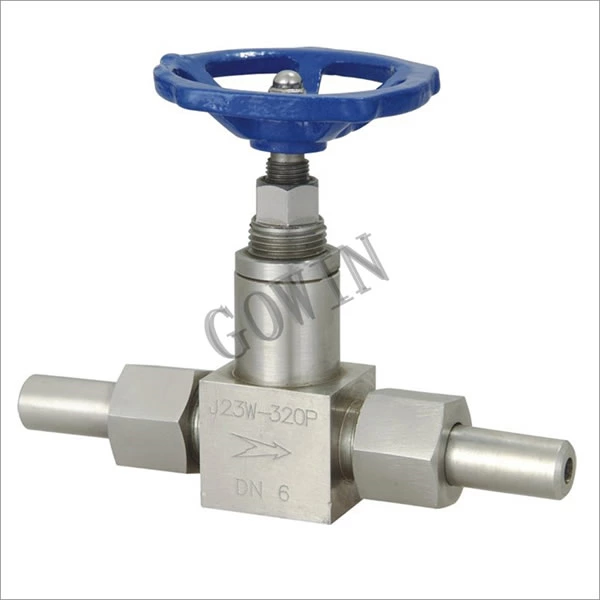
- Nominal diameter: 1/8″-1″ DN6-DN25
- Pressure: 150LB-2500LB 0.6Mpa-42.0Mpa
- End Connection: RF, RTJ, BW, THR, SW
- Temperature: -196℃-650℃
Material and Performance Comparison
| Parameter | 316SS | Duplex |
| Pressure Strength | High | Very high |
| Corrosion Resistance | Strong | Enhanced in mixed gases |
| NACE MR0175 Compliance | Yes | Yes |
| Embrittlement Resistance | Good with treatment | Improved margin |
| Cryogenic Suitability | Yes with processing | Yes with verification |
This comparison supports early engineering evaluation before final specification.
Conclusion
High-pressure needle valves for hydrogen fluid systems must combine strong materials, controlled processing, and precise sealing design.
When hydrogen needle valves are built from 316SS or Duplex materials and meet NACE MR0175 standards, they provide exemplary performance in high-pressure corrosive environments.
Careful attention to needle valve material selection, needle valve pressure drop, and thermal stability ensures safe hydrogen control across advanced energy and industrial applications.


 CHINA
CHINA LIBERIA
 FRANCE
 BARBADOS
 KIRIBATI

