


A ball valve is not a true control valve, but it can handle limited flow control in certain conditions. The difference lies in design, control accuracy, and intended function.
Many systems use both valve types, yet confusion often arises when deciding if they can perform the same role.
Understanding their structure and behavior helps clarify where each fits. This article discusses these aspects; so, be sure to read until the end.
Understanding Ball Valves and Control Valves

A ball valve uses a rotating ball with a hole through its center. When aligned with the pipeline, fluid flows freely. When turned, the flow stops completely.
This simple design makes it highly effective for on and off service. It also creates very low resistance when fully open.
A control valve, often a globe type, is built for continuous regulation. It adjusts flow using a movable plug and seat.
This design allows precise control over flow rate, pressure, and process conditions. It responds smoothly to small changes in input signals.
Comparison Overview: Which Type of Valve is Best for Controlling the Flow?
The differences between these valves can be summarized clearly.
| Feature | Ball Valve | Control Valve |
| Main Function | On and off isolation | Precise flow control |
| Flow Accuracy | Low | High |
| Rangeability | Limited | Wide |
| Pressure Drop | Low | Moderate to high |
| Sealing | Excellent | Good |
| Cost | Lower | Higher |
Flow Control Behavior and Accuracy
Flow control is where the gap between these valves becomes clear.
Control valves are designed for precise adjustment. They offer stable and repeatable flow control across a wide range.
Ball valves, in contrast, are less predictable when partially open. Small movements can cause large changes in flow.
Rangeability and Control Stability
Rangeability refers to how well a valve controls flow at different rates.
Control valves have high rangeability. They can manage both very low and very high flow conditions effectively.
Ball valves have limited rangeability. They are not designed for smooth control at low flow levels.
Sealing Performance and Leakage
Ball valves provide excellent sealing when fully closed. The tight contact between the ball and seats prevents leakage.
Control valves focus more on regulation than sealing. While they can close tightly, their main strength is controlled flow.
Pressure Drop and Energy Efficiency
Pressure drop is another key factor in valve selection.
Ball valves create minimal pressure drop when fully open. The straight flow path allows fluid to pass with little resistance.
Control valves create a higher pressure drop due to their internal design. This is necessary for effective flow regulation.
Cost and Maintenance Considerations
Cost plays a role in selecting between valve types.
Ball valves are generally more affordable, while control valves are more complex and often more expensive.
Can You Use a Ball Valve to Control Flow?
The answer is yes, but only in limited situations.
Ball valves can handle simple flow adjustment where precision is not critical. Examples include manual throttling or bypass lines.
They are also used in systems where flow changes are infrequent and not highly sensitive.
However, continuous throttling can damage the valve. High velocity flow can wear the seats and reduce lifespan.
This is why a flow control ball valve is often designed with modified trims. These designs improve control performance but still have limits.
Practical Use Cases for Limited Control
There are situations where a control ball valve can be used effectively.
In large pipelines, ball valves can manage rough flow control. Their low pressure drop makes them suitable for high flow systems.
They are also used in utility systems where precise control is not required. Examples include cooling water and general service lines.
In bypass systems, ball valves help balance flow without complex control requirements. These use cases show that while they are not true control valves, they still have practical value.
Precautions When Using Ball Valves for Control
Using ball valves for control requires careful consideration.
Partial opening can lead to erosion and cavitation. This reduces valve life and affects performance.
Flow instability is another concern. Sudden changes in flow can disrupt system operation.
To reduce these risks, special designs such as V-port balls are used. These improve control characteristics and allow smoother adjustment.
Optimized Control with Actuated Ball Valves
Modern systems sometimes combine ball valves with actuators for better performance.
Actuators allow automated operation and improved control. Options include pneumatic, electric, hydraulic, and electro-hydraulic types.
With positioners, ball valves can achieve more stable control. This expands their use in industrial applications.
However, even with these enhancements, they do not fully replace traditional control valves in precise applications.
GOWIN Valve Solutions for Industrial Systems
GOWIN offers a wide range of valve solutions designed for both isolation and control needs.
The company provides ball valve series that covers 2-piece and 3-piece designs, floating types, trunnion-mounted, and fully welded options.
These valves are built for on and off performance while supporting limited control applications.
GOWIN also offers strong actuator matching capability. Manual, pneumatic, electric, hydraulic, and electro-hydraulic options are available.
This flexibility allows systems to achieve better control and automation based on project requirements.
Founded in 2007, GOWIN has delivered valve solutions to industries such as oil and gas, chemical, metallurgy, power generation, and water systems. The company supports both local and global projects with consistent product quality and service.
GOWIN operates under ISO9001, ISO14001, and ISO45001 standards, along with certifications such as API6D, API607, and API6FA. These certifications highlight its commitment to safety, quality, and environmental compliance.
With proper configuration, GOWIN valves support both efficiency and durability in demanding environments.

Final Thoughts on Valve Selection
Ball valves and control valves serve different roles, and understanding their strengths helps avoid costly mistakes.
Ball valves excel in shutoff and low resistance flow. Control valves excel in precision and stability. Choosing the right valve improves system performance and reduces maintenance issues.
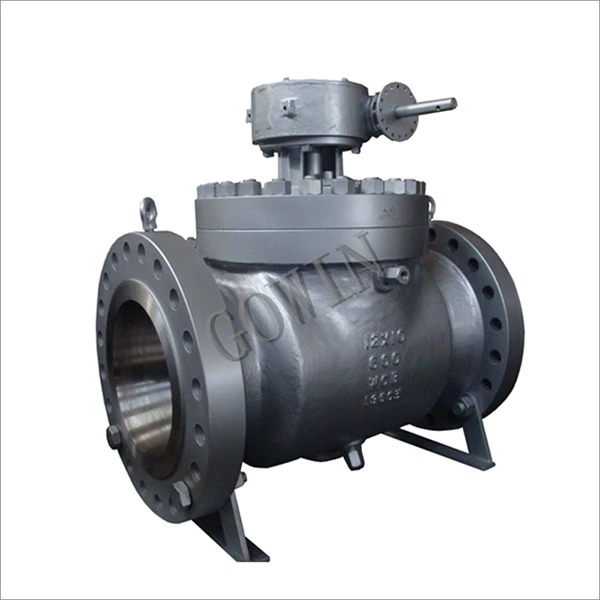
Design standard: ISO14313、API 6D、BS 5351、GB/T 19672.
Simple structure with good tightness and small torque.
One piece type body.
Have reduce bore type and full bore type with the minimum flow resistance (zero actually).


 CHINA
CHINA LIBERIA
 FRANCE
 BARBADOS
 KIRIBATI

