


Quick Answer
The choice comes down to debris load and access. A Y strainer is compact, suits high-pressure or space-limited lines, and is cleaned through a branch cap. A basket strainer has more screen area in a larger body, which usually extends the cleaning interval and handles heavier debris. Simplex baskets need a flow pause; duplex baskets allow changeover but need more space and piping.
What Is the Core Difference Between Y and Basket Strainers?

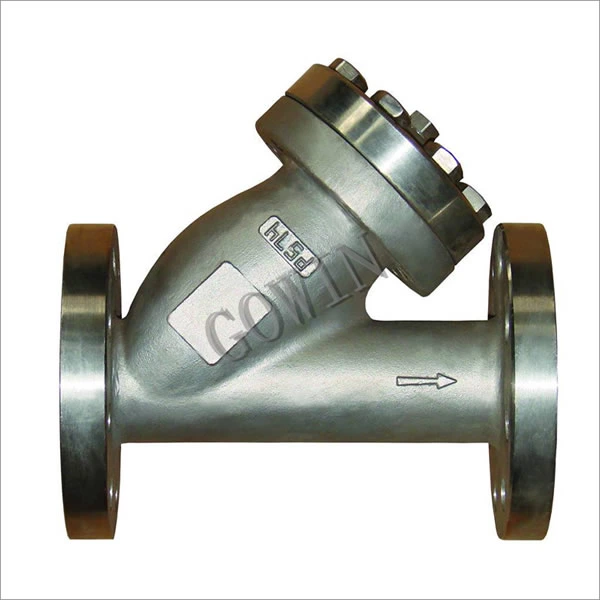
A Y strainer passes flow through a straight body and diverts it into an angled branch that holds the screen. The screen is a relatively narrow cylinder, and debris collects in the branch. Cleaning means removing the branch cap and pulling the screen out. The body is compact, which is why Y strainers are common on high-pressure lines, steam lines and crowded pipe racks.
A basket strainer uses a larger chamber and a basket-shaped screen. Flow enters the chamber, passes through the basket and exits. The basket has more surface area than a typical Y screen, so it can hold more debris before the pressure drop becomes a problem. The trade-off is a larger body, more weight and a different maintenance procedure.
That difference drives the whole y strainer vs basket strainer decision. The Y design is not a smaller version of the basket design; it is a different answer to the same problem. One prioritizes a compact envelope and simple branch access. The other prioritizes screen area and a longer cleaning interval.
Both designs can be supplied with different screen openings, materials and end connections. GOWIN’s Y strainer page and basket strainer page show the two families. The guide to industrial strainer types helps place them alongside other strainer patterns.
Which One Handles a Larger Debris Load?
In a y strainer vs basket strainer comparison, the basket type usually handles a larger debris load because it has more screen area in a larger chamber. More area means the same amount of debris creates less blockage at a given flow. That can extend the interval between cleanings, which matters on a process that cannot be stopped often.
The Y strainer can still handle a substantial debris load in the right application. Its limit is the screen area inside the branch and the frequency of cleaning the site can tolerate. On a clean line with occasional debris, a Y strainer may be entirely adequate. On a line that sheds scale, weld slag or fibrous material, the smaller screen area may blind quickly, and debris that passes the screen can still reach a pump or check valve downstream.
Debris type matters as much as debris quantity. Fibrous material can mat across a screen and reduce open area faster than granular material. Sticky debris can cling to the screen and resist blowdown. A basket design gives maintenance more room to work, but it does not make a difficult debris problem disappear. The cleaning method still has to match the debris.
The honest answer is that neither type has a universal debris-load limit. The buyer should state the expected debris, the flow, the allowable pressure drop and the cleaning interval, then ask the supplier to size the screen. A y strainer vs basket strainer comparison based only on body shape is not enough.
How Do Pressure Drop and Screen Area Compare?
Pressure drop depends on the screen opening, the open area, the flow, the fluid viscosity and the amount of debris already captured. It is not a fixed property of the strainer type. A large basket with a fine screen can have a higher pressure drop than a small Y strainer with a coarse screen, especially when the basket is loaded.
Published comparisons often disagree about which type has the lower pressure drop. That is expected because the test conditions differ. One comparison may use the same line size and a clean screen; another may use a different opening or a loaded screen. The buyer should not accept a generic claim without the basis behind it.
Ask for the pressure-drop curve or a calculated value at the design flow. Ask whether the figure is for a clean screen or a dirty screen, and what opening and viscosity were used. If the supplier cannot provide a curve, ask for the effective screen area and the opening so the offers can be compared. That is more useful than a statement that one type has less pressure drop.
Screen area is the other half of the comparison. A basket strainer generally offers more area, which can mean a lower velocity through the screen and a slower rise in pressure drop as debris accumulates. A Y strainer offers less area, but it may fit where a basket cannot. The right choice depends on which constraint is harder to solve: space or cleaning frequency.
The filter versus strainer comparison explains why a strainer is usually selected for coarse protection rather than fine filtration. If the duty needs a defined capture efficiency, a filter may be the better product family. A strainer is often the practical choice when the goal is protecting equipment and keeping the line running.
Which Design Is Easier to Clean?

A Y strainer is cleaned through the branch cap. The cap is usually smaller and lighter than a basket lid, and the screen is a single cylindrical element. That can make the job quick on a small valve. The disadvantage is that the screen sits in a narrow branch, so the clearance below the cap and the condition of the gasket both matter.
A basket strainer is cleaned by removing the lid and lifting out the basket. The larger opening gives maintenance more room, and the basket can be inspected, washed or replaced as a unit. The lid, gasket and lifting arrangement are heavier, especially on a large size. The work may need two people or a lifting device.
Simplex basket strainers require a pause in flow for cleaning. That is acceptable on a batch line or a line with a bypass, but it is a problem on a continuous process. Duplex basket strainers solve that by providing two chambers with a changeover valve, so one basket can be cleaned while the other stays in service. The cost is a larger footprint and more piping.
A Y strainer also requires isolation for cleaning, but the smaller body may make it easier to fit a pair of isolation valves close to the strainer. The gate valve category and API 600 gate valve page show common isolation options. A manual butterfly valve or a wafer butterfly valve can save space on a tight line. Plan the isolation and the cleaning access together, not after the strainer is installed.
When Does a Duplex Basket Strainer Make Sense?

A duplex basket strainer makes sense when the process cannot stop for cleaning and the debris load is high enough to need frequent attention. It provides two baskets in one assembly, with a diverting valve that lets maintenance switch flow from the dirty basket to the clean one. The dirty basket is then opened and cleaned while the line continues to run.
That convenience has a cost. A duplex unit needs more space, more piping, more valves and a heavier support. It also needs a clear operating procedure so the changeover is done in the right sequence. If the procedure is unclear, the operator may bypass the strainer or leave both baskets in a partially open position.
A simplex basket with a bypass line can provide some of the same continuity, but it adds valves and a second flow path. A Y strainer with a bypass can do the same on a smaller scale. The decision is not only about the strainer; it is about the isolation and bypass arrangement around it.
Use a duplex design when the production cost of a shutdown is clearly higher than the cost of the larger assembly. Use a simplex design when the line can be paused, or when the debris load is low enough that cleaning is infrequent. If the site cannot answer that question, start with the maintenance interval and work backward.
Which Data Should You Request Before Choosing?
Ask for the same data from every supplier so the offers can be compared. The list below is a practical RFQ checklist, not a substitute for the project specification.
| Data | Why it matters | Y strainer | Basket strainer |
|---|---|---|---|
| Screen opening | Sets capture and pressure drop | Confirm micron or mesh | Confirm micron or mesh |
| Effective screen area | Affects cleaning interval | Smaller branch area | Larger chamber area |
| Pressure-drop basis | Shows whether the claim applies | Ask for curve or calculation | Ask for curve or calculation |
| Cleaning access | Decides maintenance time | Branch cap clearance | Lid and basket lifting space |
| Installed envelope | Decides whether it fits | Compact | Larger footprint |
| Support needs | Carries weight and thermal load | Usually lower | Usually higher |
| Isolation and bypass | Allows cleaning without a shutdown | Plan valves and space | Plan valves, bypass or duplex |
Add the fluid, flow, temperature, pressure class, body material, end connection and debris description. If the line carries fibrous or sticky debris, say so; the screen choice and cleaning method may change. If the process cannot stop, say that too, because it may rule out a simplex basket before the price comparison begins.
GOWIN’s Y strainer and basket strainer pages show the product families, while the valve material guide helps align the body and screen materials with the fluid. For the isolation package, compare the ball valve category and floating ball valve page with the butterfly valve category.
Standard: ASME, API, JIS, BS, DIN, GB, JB, HG
Conclusion
Choose a Y strainer when space, weight or pressure class matter more than screen area, and the line can be cleaned through a branch cap. Choose a basket strainer when the debris load is heavier and a larger screen area can extend the cleaning interval. Choose a duplex basket only when the process truly cannot stop and the larger assembly can be supported.
Do not decide from a generic claim about pressure drop. Compare the opening, screen area, pressure-drop basis, cleaning access and installed envelope. Those five data points will show which design fits the duty, and which quotation is actually comparable.
Send the medium, size, operating pressure and temperature, and the relevant drawing for a duty-specific quotation.


 CHINA
 LIBERIA
 FRANCE
 BARBADOS
 KIRIBATI


