


Quick Answer
A full port vs standard port ball valve decision depends on the duty, not a default rule. Full port gives an open bore close to the pipe inside diameter, reducing added resistance and allowing easier passage of pigs or solids. Standard port uses a smaller bore and a more compact body, but it creates higher velocity and pressure drop at the same flow. Compare actual bore and Cv.
What Is a Full Port vs Standard Port Ball Valve?
A ball valve controls flow with a drilled ball that rotates inside the body. Port size describes the opening through that ball. It affects flow capacity, pressure drop, cleaning and the space the valve needs.
A full-port ball valve, also called full bore, has an opening approximately equal to the inside diameter of the connected pipe. The bore is not necessarily a perfect match on every model, so the drawing should still be checked. Full port reduces the extra restriction created by the valve, but it does not make pressure drop zero.
A standard-port ball valve, also called reduced port, uses a smaller ball opening. The body may stay close to the line size while the bore is smaller, often roughly the next smaller pipe size. That is a useful description, not a universal dimension.
Neither design is automatically better. The right choice comes from the flow requirement, acceptable pressure loss, line-cleaning method, fluid and available space.
Why Does Bore Size Affect Flow and Pressure Drop?
For the same flow rate, a smaller bore produces a higher fluid velocity. Higher velocity generally means more friction and a larger pressure drop across the valve. The effect becomes more important in long runs, low-pressure systems, high-flow duties and lines that are already close to their hydraulic limit.
A larger bore lowers the added velocity and restriction. That can help maintain flow and reduce pump energy, but the benefit must be judged against the whole line. Elbows, strainers, reducers and other fittings also contribute to pressure loss. Replacing one valve does not fix a poorly sized system.
Bore size also affects how the line behaves with solids. A full-port valve gives a more open path, which can be useful for slurries, fibrous material or lines that must pass a cleaning pig. A reduced bore creates a step or restriction that may trap material or block the cleaning device.
Do not assume that a larger bore solves every problem. A viscous fluid, a low-flow duty or a line with a wide size change may need a different valve type or a system review. The gate valve versus ball valve article explains why the isolation duty matters before the bore is fixed.
How Do Cv and Actual Bore Compare?
Cv is a flow coefficient. In plain terms, it expresses how much flow a valve can pass for a given pressure drop under defined test conditions. A higher Cv means greater flow capacity, but Cv values are only comparable when they come from the same basis and test method.
Do not choose a valve from a nominal size alone. Two valves marked as the same line size may have different bores, seat designs and flow paths. Ask for the actual bore and the published Cv for the offered model. Then compare those values at the required flow and allowable pressure drop.
A full-port design often has a higher Cv than a standard-port design of the same line size, but the difference depends on the models. The valve opening percentage, seat geometry and body cavity also affect performance. A catalogue chart cannot replace the model data.
| Selection check | Full port | Standard port |
|---|---|---|
| Bore | Approximately pipe inside diameter | Smaller than line size |
| Added pressure drop | Usually lower for the same model size | Usually higher at the same flow |
| Flow capacity | Usually higher | Usually lower |
| Pig or solids passage | More open path; verify internal geometry | May obstruct the path |
| Size and weight | Often larger and heavier | Often more compact |
| Best starting point | Low pressure loss, pigging, high flow | Space, weight and adequate hydraulic margin |
The table is a screening aid. The actual bore, Cv and pressure-drop calculation belong in the technical review.
When Does Full Port Justify Its Larger Envelope?
Full port deserves close attention when the line needs a low-resistance isolation point, when the available pressure is limited, or when the fluid must pass without a narrow step. It is also a common choice for pigging and for lines where debris or solids could collect at a restriction.
The larger ball and body can increase weight and require more space. Installation layout, support, actuator clearance and maintenance access all matter. A full-port valve that cannot be supported or serviced is not a practical choice, even if its hydraulic performance is better.
The cost comparison should cover the whole valve package. A larger body may use more material, but price also depends on the material grade, pressure class, trim, actuation, testing and documentation. Do not apply a fixed percentage difference from one product family to another.
GOWIN’s floating ball valve page shows a common ball-valve family for smaller and medium line duties. For larger or higher-load applications, compare the side-entry trunnion ball valve and the ball valve category. The construction and bore data still need to be confirmed for the exact model. For a fully welded pipeline, review the fully welded ball valve construction separately from the bore choice.
When Is Standard Port the Practical Choice?
Standard port can be the practical choice when the smaller bore still leaves enough hydraulic margin and the installation benefits from a more compact valve. It can suit space-limited skids, lower-flow branches and duties where the pressure drop has been checked rather than assumed.
It can also make sense when the line does not need pigging and the fluid is clean. A smaller bore may reduce the ball and body envelope, but the buyer should still check the Cv, velocity and pressure loss at the design flow.
Do not select standard port only because it looks smaller or less expensive. If the pump has little spare head, if the line must run near its design capacity, or if the fluid contains solids that can settle at a step, the reduced bore may create operating problems.
The same review applies to other compact valve families. The manual butterfly valve may save space, but its disc and seat create a different flow path. The API 600 gate valve and the gate valve category include several designs whose bore and pressure-loss behavior should be checked model by model, not assumed from the category.
What Should the RFQ and Drawing Confirm?
The RFQ should state the line size, required flow, allowable pressure drop, medium, design pressure, design temperature and whether the line must be pigged or pass solids. Add the valve type, body material, seat material, end connection and operation method.
| RFQ item | Why it matters |
|---|---|
| Actual bore | Confirms the flow path, not just the nominal size |
| Cv or flow data | Supports the pressure-drop check |
| Design flow | Shows whether the valve is sized for the duty |
| Allowable pressure drop | Sets the hydraulic limit |
| Medium and solids | Affects clogging and cleaning risk |
| Pigging requirement | Requires a clear internal path |
| Space and weight limit | Affects body and actuator selection |
| Drawing | Connects the offered model to the line |
Ask for the face-to-face dimension, body length, weight and operator envelope if the valve goes into a constrained skid or a retrofit. A dimensional check can prevent a technically suitable valve from failing at installation.
For adjacent equipment, the cast steel check valve, check valve category and end connection guide help separate the bore decision from the joint and backflow-protection decisions. The 2-piece ball valve and 3-piece ball valve pages show how maintenance style can change the body arrangement without changing the basic port question.
GOWIN supplies several ball-valve constructions and other industrial valve families. Use the product page to shortlist the body style, then compare the actual bore, Cv and drawing for the quoted model.
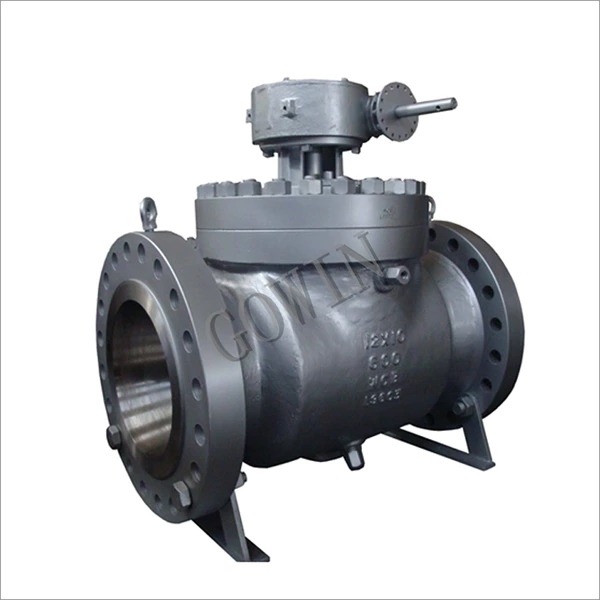
- Nominal diameter: 2″-60″ DN50-DN1500
- Pressure: 150LB-2500LB 2.5Mpa-42.0Mpa
- End Connection: RF, RTJ, BW, THR, SW
- Temperature: -196℃–650℃
Conclusion
For a full port vs standard port ball valve choice, start with the hydraulic duty. Choose full port when low added resistance, pigging or solids passage matters enough to justify the larger envelope. Choose standard port when the smaller bore meets the flow and pressure-drop limits and space or weight is the stronger constraint.
Do not use a blanket flow-loss percentage or assume that every valve in a family has the same bore. Ask for actual bore, Cv, dimensions and the drawing, then check them against the design flow.
Send the medium, size, operating pressure and temperature, and the relevant drawing for a duty-specific quotation.


 CHINA
 LIBERIA
 FRANCE
 BARBADOS
 KIRIBATI


