


Quick Answer
Piece count describes how the body is split, not how well the valve performs. A two-piece valve has one body joint; a three-piece valve adds a centre section between two end pieces. Fewer joints reduce cost and sealing interfaces; more joints improve access to the ball and seats. Match the body style to maintenance access, piping space, size and pressure class.
What Does the Piece Count Actually Describe?
It describes the number of body joints. A one-piece valve has a single body with no split. A two-piece valve has a body and one end piece, joined at a single flange or thread. A three-piece valve has a centre body between two end pieces, so it has two body joints.
Nothing about that definition says which valve seals better. Sealing quality comes from the seat design, the surface finish, the ball roundness and the assembly clearance. A well-made two-piece valve can outperform a poorly made three-piece valve at the same pressure class.
What the piece count changes is access. Every joint you add is a place you can open. That matters when the seats, seals or ball need attention. It also matters when they do not, because every joint is another interface to machine, assemble and test.
The ball valve category shows the families normally offered. Within them, body style is a separate decision from bore, seat material and end connection.
How Do Two-Piece and Three-Piece Bodies Differ?

A two-piece body splits once, usually at the downstream end. The ball, seats and stem go into the main body, then the end piece closes the assembly. The result is a compact body with one gasket or O-ring interface and a short overall length.
A three-piece body splits twice. The centre section holds the ball and seats, and two end pieces clamp it from either side. That gives you a centre section you can lift out once the line is opened and the end pieces are spread. The trade-off is two sealing interfaces and a longer assembly.
On small threaded valves, that centre section can sometimes be swung out by hand for a quick seat change. Do not carry that image into large API 6D valves. A 20-inch, Class 900 three-piece body is a crane and rigging job, and the line still has to be drained and isolated. The maintenance advantage is real, but it is measured in shutdown hours, not minutes.
GOWIN’s 2 PCS ball valve covers 2 inch to 60 inch (DN50 to DN1500), Class 150 to 2500, with RF, RTJ and BW ends. The 3 PCS ball valve covers 2 inch to 40 inch (DN50 to DN1000), Class 150 to 4500, with the same end connections. Those ranges are close, so the choice is rarely about availability alone.
| Decision point | Two-piece body | Three-piece body | What the buyer should verify |
|---|---|---|---|
| Body joints | One joint; fewer sealing interfaces | Two joints; a removable centre section | Joint gasket or O-ring material and test scope |
| Seat and ball access | Less direct; the valve may need to leave the line | Usually faster, if the end pieces can be spread | Required gap, lifting plan and shutdown time |
| Piping space | More compact and easier to fit in a crowded line | Needs room to separate the end pieces or remove the centre | Face-to-face drawing and site clearance |
| Leak paths | One body interface to assemble and test | Two body interfaces to assemble and test | Body-joint pressure test and traceability |
| Large-size maintenance | A crane may be needed for the complete valve | A crane and rigging may still be needed for the centre section | Whether the maintenance plan assumes bench-scale access |
| Economic fit | Long isolation periods and price-sensitive projects | Frequent seat inspection or a plan that values faster access | Five-year cost: parts, labour and lost production |
The ball valve is designed in accordance with ISO14313、API 6D、BS 5351、GB/T 19672;
View Product Details
Which Design Gives Faster Maintenance Access?
The three-piece design usually wins on access to the ball and seats, provided the piping allows the end pieces to be spread. That condition is easy to miss. A valve bolted between two fixed flanges with no expansion joint may not give you the gap the drawing assumes.
Two questions decide the answer. First, can the centre section be removed in the installed position, or does the valve have to come out of the line? Second, what else has to be disconnected, lifted or supported to make that happen?
A two-piece valve is not automatically hard to service. Its single joint still opens the body, and on some designs the ball and seat can be reached from that side. The route is simply less direct, and the whole valve often has to leave the line.
GOWIN lists independent ball and stem construction, cavity pressure self-relief and emergency sealant injection on both the 2 PCS and 3 PCS ranges. Those features change the maintenance plan. Independent ball and stem means the stem can be serviced without disturbing the ball in some configurations. Sealant injection gives maintenance a way to restore seat sealing temporarily without opening the body. Cavity relief protects the body cavity from overpressure when thermal expansion occurs.
Treat each of those as a scope item to confirm on the approved drawing. A catalogue sentence is not a guarantee that a specific size or trim includes it. The top-entry versus side-entry comparison explains the other main access route if top entry is on your list.
Do More Joints Mean More Leak Paths?
Yes, in principle. Each body joint needs a gasket or an O-ring, and each of those is a potential leak path. A three-piece body has two such interfaces instead of one, so it has more places where assembly quality, bolt torque and surface finish matter.
That does not make a three-piece valve leak-prone. It makes the assembly and test process more demanding. A supplier that controls bolt tension, gasket compression and body test pressure will deliver a dry valve in either style. A supplier that does not will struggle with both.
The practical consequence for a buyer is in the test scope. Ask for the body shell test and the seat test on the finished valve, not just on the components. Ask whether the body joints are tested after final assembly at the specified pressure. The API 6D explainer sets out what that standard expects from a valve in this family.
Fire-safe and anti-static features belong in the same conversation. GOWIN lists fire-safe construction, anti-static design and an anti-blowout stem on both ranges. Those features matter most at the joints and at the stem, which is exactly where a body split adds complexity. The same standard family also governs swing check valves, so a project that cites API 6D usually applies one test language across the valve list.
Which Valve Fits Your Pressure, Temperature and Size?
Start with the service envelope, then let the body style follow. For most soft-seated ball valves, the temperature ceiling arrives before the pressure ceiling. GOWIN lists -46 to +200 degrees C for the 2 PCS range and -50 to +200 degrees C for the 3 PCS range. Those are catalogue limits for the listed seats, not a promise for every trim.
Pressure class is the next filter. Both ranges cover Class 150 to 2500. The 3 PCS range extends to Class 4500, so if your line is above Class 2500 the choice is already made. Below that, both are available across a wide band.
Size is the third filter. The 2 PCS range reaches 60 inch, while the 3 PCS range stops at 40 inch. If the line is larger than 40 inch, the two-piece body is the only option in this catalogue. If it is smaller, either body can be quoted.
The ball valve is designed in accordance with ISO14313、API 6D、BS 5351、GB/T 19672;
View Product Details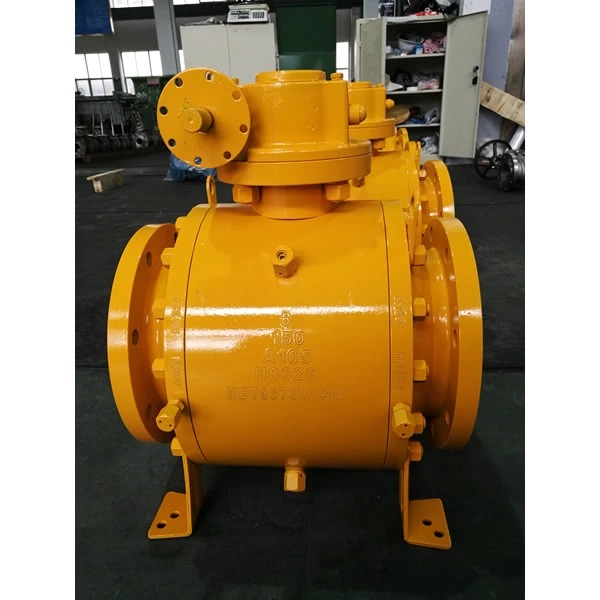
Bore is a separate decision. Both ranges offer full and reduced bore. A reduced bore costs less and takes less space, but it adds pressure drop. The floating ball valve page shows how the smaller family presents the same choice. Do not let the body style decision hide the bore decision, because bore affects pumping cost every day the line runs.
How Do You Compare Lifecycle Cost and Spares?

In a 2 piece vs 3 piece ball valve comparison, put both offers on the same size, class, bore, trim and test scope, then compare five lines: purchase price, spare parts, labour, production lost during repair, and actuator cost if the valve is automated.
The two-piece valve usually wins on purchase price and on the number of sealing interfaces. The three-piece valve usually wins on repair time, because the centre section can be replaced or reworked without cutting the whole valve out of the line. Whether that time saving pays for the extra joint depends on how often the valve is serviced and what a shutdown hour costs at your plant.
Spares are where the comparison often breaks down. Ask each supplier for the recommended spare list: seats, seals, gaskets, stem packing and, for a three-piece valve, the body joint gaskets. Ask whether those parts are available as a kit and whether the kit is tied to the valve serial number. A cheap valve with no spares plan is not cheap over ten years.
The valve material guide helps here, because body and trim material drive both the price and the spare parts route. The end connection guide matters too: a welded valve is harder to remove than a flanged one, which changes the value of in-line access.
What Should the Drawing and RFQ Include?
Write the requirement so two suppliers cannot quote different scopes under the same description.
- Size, pressure class and design standard, with the edition. For this family, state whether API 6D, ISO 14313, BS 5351 or GB/T 19672 applies.
- Bore: full or reduced, with the port diameter or required Cv.
- Body style: two-piece or three-piece, and whether in-line centre-section removal is required.
- Body, ball, stem and seat materials, with any NACE or low-temperature requirement.
- End connections and the mating flange standard.
- Temperature range, including upset conditions.
- Operation: lever, gear, pneumatic or electric, with fail position. The pneumatic valve overview explains the common arrangements.
- Test scope: shell, seat, body joint and any witness requirement.
- Documentation: approved drawing, bill of materials, test report and spare parts list.
- Tagging, painting, packing and destination.
Add two questions that are specific to this decision. Can the valve be serviced without removing it from the line, and what gap does that require? Which spare parts should be held for the first two years?
For the 2 piece vs 3 piece ball valve decision, the drawing is the evidence. A general arrangement drawing shows the joint positions, the face-to-face length and the space needed to open the body. A bill of materials shows whether the seats and seals are the ones you specified. Neither is a substitute for the other.
Conclusion
Choose the two-piece body when the line is large, the valve is expected to run for long periods without seat work, and purchase price and joint count matter. Choose the three-piece body when seat or ball access is part of the maintenance plan and the piping can give you the space to open it.
That is the short answer to the 2 piece vs 3 piece ball valve question. It is a maintenance decision with a cost consequence, not a quality ranking. If the service is clean and the valve is expected to stay closed or open for years, the simpler body usually earns its place. If the service is dirty, cycling, or hard on seats, the faster access route can pay for itself.
If the line is being specified from scratch, the gate versus ball comparison and the gate valve category cover the isolation decision one level up. The API 600 gate valve page shows the linear-stroke alternative. If the valve will be used to control flow rather than isolate it, the throttling guide and the wedge gate throttling analysis explain why a ball valve is the wrong tool for that job.
For installation and actuator questions, the ball valve installation guide covers the site work that this article deliberately leaves out.
Send service media, size, pressure, temperature and the relevant drawing for a quotation.


 CHINA
 LIBERIA
 FRANCE
 BARBADOS
 KIRIBATI


