


Быстрый ответ
The butterfly valve parts are the body, disc, stem and seat. The body sets the pressure boundary, the disc controls flow, the stem carries torque and the seat makes the seal. Shaft seals, bearings and the operator complete the assembly. Material and seat choices decide whether two same-size valves perform alike. GOWIN lists wafer butterfly valves from 2 to 120 inches, Class 150 to 600.
What Parts Make Up a Butterfly Valve?

The main butterfly valve parts are the body, disc, stem and seat. Around them sit the shaft seals or packing, the bearings or bushings, the gland area and the operator. A position indicator may be added so the plant can see whether the valve is open or closed.
The body holds the internals and connects to the pipe. The disc sits in the flow path and rotates to open, throttle or close. The stem connects the disc to the operator and carries the torque. The seat, often a liner in a soft-seat valve, is the surface the disc closes against.
Each of the butterfly valve parts has a separate failure mode. A corroded body leaks to atmosphere. A worn seat leaks past the closed disc. A damaged stem seal leaks along the shaft. A dry or misaligned bearing raises torque and can make the actuator look undersized. That is why a quotation that lists only body material and pressure class is incomplete.
The table below turns the butterfly valve parts list into a buyer’s check.
| Part | What it does | What the buyer should confirm |
|---|---|---|
| Тело | Holds the internals and forms the pressure boundary | Style, material, pressure class and end connection |
| Disc | Rotates across the bore to control flow | Material, edge profile and concentric or offset design |
| Корень | Transmits torque from the operator to the disc | Material, diameter, anti-blowout feature and drive connection |
| Seat or liner | Provides the shutoff surface | Soft or metal seat, compound, temperature limit and replaceability |
| Shaft seal | Stops leakage along the stem | Seal or packing type, emission requirement and temperature range |
| Bearings | Keep the stem aligned and reduce friction | Bushing material, lubrication and expected operating torque |
The butterfly valve category shows the families normally offered. Use it to identify the product family, then use the drawing to confirm the component build.
Which Body Style Fits the Line?
The three common body styles are wafer, lug and double flanged. They differ in how the valve is held between pipe flanges and in what maintenance is possible later.
A wafer body sits between two flanges and is clamped by the flange bolts. It takes very little pipe length, which suits large water and HVAC lines where space is tight. Its weakness is dependence on both flanges. If one side is unbolted, the valve can lose support.
A lug body has threaded or drilled lugs on both sides. It still fits between flanges, but each side can be bolted independently. That allows one side of the line to be opened while the valve remains in place. The lug versus wafer comparison explains where that matters in practice.
A double-flanged body has its own flanges and a face-to-face length. It is heavier and longer, but it can be removed without spreading the pipeline and it is easier to support. It suits lines that will be opened for maintenance or where the piping layout cannot clamp a wafer valve safely.
Body material is a separate choice. Carbon steel is common for water and non-corrosive service, stainless steel for corrosive or clean duty, and alloy steel for higher temperature. The valve materials guide sets out how that choice affects price and spare-parts route.
GOWIN lists wafer butterfly valves from 2 to 120 inches, Class 150 to 600, for -46 to 200 C, with carbon, stainless and alloy bodies. Available ends are RF and RTJ, and operation can be manual, worm gear or electric. Those are catalogue ranges; the offered drawing still governs the actual build.
What Do the Disc and Stem Actually Do?
The disc is the moving flow boundary. In the open position it turns parallel to the flow and leaves the bore clear. In the closed position it turns across the flow and presses against the seat. In between it throttles, though a standard butterfly valve is not a precision control device.
Disc material matters because the disc is wetted and constantly exposed. A disc that corrodes or erodes at the edge will not seal cleanly, even if the seat is new. Stainless steel is the usual step up from cast iron for corrosive duty. Higher alloys appear when the media attacks stainless steel.
The stem transfers torque from the handle, gearbox or actuator to the disc. It also passes through the body, so it creates a leakage path that has to be sealed. A one-piece stem is common in general service; a split or two-piece stem appears in some designs. The buyer does not need to choose the stem design, but should ask what it is when the service is corrosive, abrasive or frequently cycled.
Stem strength shows up as torque. A stem that is undersized or corroded can twist, and a bent stem makes the disc run off centre. That is why a quote that offers a larger actuator to fix a stiff valve may be treating the symptom rather than the cause.
How Does the Seat or Liner Affect Shutoff?
The seat is the main sealing interface. In a soft-seat valve it is usually a resilient liner that the disc edge compresses. In a metal-seat valve the disc and seat contact metal, sometimes with a conical geometry that only touches at the last part of the stroke.
Seat compound decides media compatibility and temperature. EPDM, nitrile, PTFE and FKM are common families, and each has a different resistance profile. A compound that swells in one fluid may be ideal in another. The supplier should confirm the offered compound against the media, concentration and temperature, not just the valve size.
Seat design also decides how much torque the valve needs. A liner that is compressed through the whole stroke creates friction and wears faster. A design that lifts the disc away before it turns reduces that wear but costs more. The triple eccentric explainer describes how that geometry changes seat contact.
A shutoff class is a test result, not a material property. GOWIN’s soft-seat wafer page states ANSI B16.104 Class VI. Treat that as a statement for the soft-seat build and confirm the class on the offered drawing and test report. Do not assume every variant of the same size reaches the same result.
What Do Shaft Seals and Bearings Protect?

The shaft seal, packing or gland sits where the stem passes through the body. It stops process fluid from leaking along the stem. This is a small area with a large consequence: a worn seal produces a visible drip, a vapour release or a slow loss of pressure, and it can be mistaken for a seat leak.
Seal design depends on the service. A soft-seat water valve may use O-rings. A higher-temperature valve may use packing or a graphite stem seal. The right choice depends on media, temperature, pressure and how often the valve cycles. A seal that is correct for water may fail quickly in a solvent.
Bearings and bushings keep the stem aligned and reduce friction. They are not usually the first parts a buyer asks about, but they affect operating torque and actuator sizing. A dry bearing raises torque, and a raised torque can lead to a larger actuator, a bigger air supply or a manual valve that is hard to turn.
Ask for the seal and bearing materials in the quotation when the line handles aggressive media, high temperature or frequent cycling. If the supplier cannot name them, the offer is not yet specific enough to compare.
Manual or Actuated: Which Operator Should You Specify?
The operator is the butterfly valve part the plant interacts with. A lever suits a small valve that is operated occasionally. A worm gear suits a larger valve where the torque is too high for a lever. A pneumatic or electric actuator suits remote operation, interlocking or frequent cycling.
Actuator choice changes more than convenience. It sets the mounting interface, the air or power requirement, the stroke time and the fail position. A spring-return actuator can close or open on air failure, but the direction has to be stated. A double-acting actuator holds position when air is lost.
The pneumatic butterfly valve guide covers the common arrangements. GOWIN lists manual, worm gear and electric operation for its wafer range; pneumatic actuation should be confirmed for the specific model and size.
Do not size an actuator from the valve size alone. The required torque depends on pressure differential, seat friction, media and cycling. The valve supplier and actuator supplier should confirm the interface and torque in writing.
Стандарт проектирования согласно: API 609, ASME B16.34, GB/T12238, JB/T 8527.
Просмотреть подробную информацию о товаре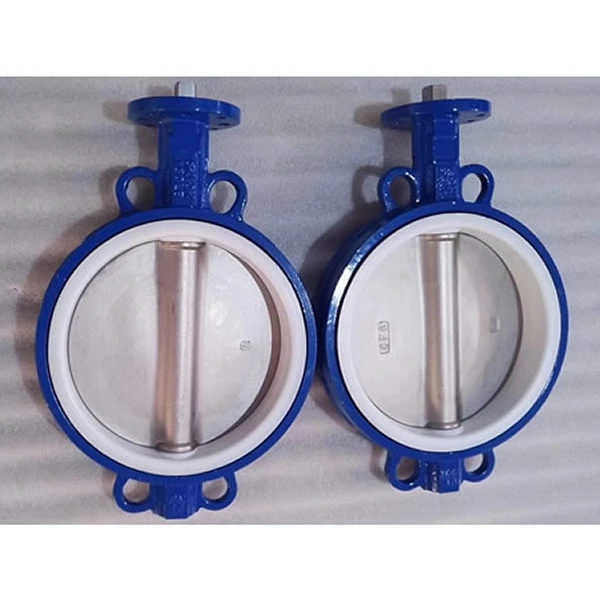
Заключение
Start with the duty, then fix the parts. For general water and HVAC isolation, a concentric soft-seat wafer valve with a carbon steel body and a suitable resilient seat is usually the economical choice. For a line that must be opened on one side, move to a lug body. For a line that needs a removable, supported valve, consider a double-flanged body.
For higher temperature or a line that cycles often, check whether a metal seat or an offset design is justified. For corrosive media, fix the body, disc and seat materials before comparing price. For automation, state the fail position and the available air or power supply.
Then write the RFQ in component terms: size, pressure class, body style, body material, disc material, stem material, seat compound, shaft sealing, end connection, operation and required test. Add the media, concentration, temperature and any solids. That list lets a supplier answer precisely and lets you compare offers without guessing.
If the line is better served by a linear-stroke valve, the gate valve category и API 600 gate valve are the isolation alternative, with the globe valve covering throttling duty. For non-return duty, the check valve category и cast steel check valve cover the next decision. For quarter-turn isolation at higher pressure, the ball valve category is the other branch.
The end connection guide helps when flange, threaded or welded ends are still open. The API 6D overview matters when the line is specified to a pipeline standard. If the valve will be used to regulate flow rather than isolate it, read the throttling guide before assuming a butterfly valve is the right tool.
A butterfly valve parts list becomes useful only when each line has a material, a standard or a test behind it. Ask for that evidence, compare it with the drawing, and keep the approved component list with the purchase order.
Send service media, size, pressure, temperature and the relevant drawing for a quotation.


 КИТАЙ
 ЛИБЕРИЯ
 ФРАНЦИЯ
 БАРБАДОС
 КИРИБАТИ


