


Réponse rapide
A ball valve is built for on-off isolation: a quarter turn takes it from full bore to shut. A needle valve is built for throttling: a tapered needle on a fine thread sets low flow in small, repeatable steps. Choose by duty, not price. Most lines need a ball valve to isolate and a needle valve only where fine adjustment matters. GOWIN supplies both.
Are Both Valves Used for Flow Control?
Yes, but they control flow in different ways, and that difference decides the purchase.
On-off control means the valve is either fully open or fully closed. Flow is at full rate or at zero. A ball valve belongs in this group. It can be cracked open, but it has no accurate setting and no repeatable relationship between handle angle and flow rate.
Throttling control means the valve holds a flow rate somewhere between zero and full. A needle valve belongs in this group. Its whole purpose is to make small, controlled changes to the opening and hold them.
A buyer who compares a ball valve and a needle valve on price alone is comparing two different jobs, and that is the first trap in any ball valve vs needle valve evaluation. Ask first whether the line needs isolation, adjustment, or both. The ball valve category covers the isolation side of that question.
| Decision | Ball valve | Needle valve |
|---|---|---|
| Primary duty | Isolation marche/arrêt | Fine throttling and metering |
| Adjustment | Quarter turn; not repeatable at part open | Fine thread; small, repeatable steps |
| Flow capacity | Full bore keeps pressure drop low | Narrow path; low capacity and high pressure drop |
| Contamination | Seat wipes the ball and can pass larger solids | Small gap blocks easily; needs clean fluid |
| Position indication | Handle shows open or closed | Handle angle does not show position |
| Automation | Easy to actuate | Usually manual; automation is uncommon |
| Best fit | Isolation, gas, water and process lines | Sampling, bleed, gauge and metering lines |
How Does a Ball Valve Work?
A ball valve has a sphere with a straight bore through it, held between two seats inside the body. Turn the handle a quarter turn and the bore lines up with the pipe, so flow passes through. Turn it back and the solid side of the sphere faces the flow.
Three features matter to a buyer.
The handle shows the state. If the handle is in line with the pipe, the valve is open. If it is across the pipe, the valve is closed. That sounds trivial until you are standing in a plant at night with a line that must be isolated.
The seat wipes itself. As the ball rotates, the seat wipes the ball surface and clears light build-up. With few internal parts, there is little to maintain.
The bore sets the pressure drop. A full-port ball valve has a bore close to the pipe inside diameter, so a fully open valve adds very little resistance. A reduced-port valve costs less and takes less space, but it restricts flow.
GOWIN lists floating ball valves from DN15 to DN250 in Class 150 and 300, rated from -50 to +400 C, with RF, BW or threaded ends, full or reduced bore, and fire-safe, anti-static and anti-blowout construction. The floating ball valve page carries that range. Larger or higher-pressure lines move to the 2 PCS ball valve or the 3 PCS ball valve, which extend to Class 2500 and Class 4500 respectively.
How Does a Needle Valve Work?

A needle valve has a tapered, needle-shaped plug on the end of a stem. The stem runs in a fine thread. Turning the handle moves the needle a small distance along its axis, so the gap between needle and seat changes gradually.
That geometry is the whole product. The operator can set the valve barely open, half open or fully open, and can return to a setting by counting turns. The result is fine, repeatable adjustment at low flow.
The same geometry explains the limits. The flow path is narrow even when the valve is wide open, so capacity is low and pressure drop is high. Full travel takes many turns, which makes the valve slow to open and close. And because the handle turns freely through that travel, the handle position alone does not tell you whether the valve is open or shut.
GOWIN lists needle valves from 1/8 to 1 inch, Class 150 to 2500, rated from -196 to +650 C, with RF, RTJ, BW, threaded or socket-weld ends. The needle valve product page sets out that range, and the needle valve category shows the wider family. For manifold work, the needle valve and manifold guide explains where these valves sit in an instrument hookup.
Ball Valve vs Needle Valve: Which Gives Finer Adjustment?
The needle valve, by a wide margin.
A fine thread converts one turn of the handle into a small axial movement of the needle. Because the needle is tapered, that small movement produces a small change in the open area. The operator can trim flow in increments and stop where the reading is right.
A ball valve has no equivalent. The opening changes as the bore rotates past the seat, and the useful travel is concentrated in a narrow band near the closed position. A few degrees of handle movement can take the valve from a trickle to a rush. The relationship is not linear, it shifts as the seat wears, and it is not repeatable from one valve to the next.
Throttling a ball valve also costs seat life. Near the closed position the velocity across the seat is high, and the seat takes the wear. That is why ball valve makers describe the product as an on-off valve and warn against extended throttling.
There is a second, practical difference. A needle valve holds a setting. A ball valve left part-open can drift, because nothing in the design locks the ball at that angle. If the process needs the same flow rate tomorrow, the needle valve is the instrument for the job.
Which Valve Handles Higher Flow?
The ball valve, and it is not close.
A full-port ball valve passes flow through a bore close to the pipe size, with a short, straight path. Pressure drop at full open is small. The valve is available in sizes that match process pipework, and it can be actuated for fast, remote operation.
A needle valve is a small-bore device. GOWIN’s range stops at 1 inch. Even at full open, the flow passes through the narrow gap around the needle, so the valve restricts the line by design. That restriction is useful when you are metering a sample or a bleed, and it is a problem when the line has to move volume.
If the duty is high flow with throttling, the answer is usually a globe valve or a control valve rather than either of these two. The globe valve category and the globe valve product cover that middle ground, and the control valve trim guide explains how trim choice changes the flow characteristic. For automated duty, the types de vannes pneumatiques guide covers the actuator options.
For pure isolation at high flow, the gate valve category and the API 600 gate valve are the usual alternatives to a large ball valve, and the throttling guide compares the valves that are actually built for control duty.
What About Pressure Drop and Contamination?
Pressure drop is a design feature here, not a fault.
In a ball valve, a full-port body keeps pressure drop low at full open. That is what you want for isolation, because the valve should disappear from the line’s hydraulics when it is open. A reduced-port body trades some of that away for cost and size.
In a needle valve, high pressure drop is part of the metering mechanism. A large, predictable drop across the needle gives the operator something to adjust against. If the line cannot afford that drop, the needle valve is the wrong choice regardless of how well it regulates.
Contamination is the other half of the question.
Ball valves tolerate dirty service better than needle valves in one sense: the seat wipes the ball on each stroke, and the bore is large enough to pass solids that would block a needle valve. But suspended solids and sticky media can still build up on the ball and seat, and that build-up abrades the sealing surfaces over time. A ball valve that is left part-open in dirty service is the worst case, because the same narrow band of seat is exposed to the highest velocity.
Needle valves have the opposite problem. The gap between needle and seat is small, so a particle that passes through a ball valve can lodge in a needle valve and change the setting. Fine strainers and clean instrumentation duty are the normal pairing.
Material choice affects both. A corrosive line may call for a stainless or alloy body, and a high-temperature line narrows the options further. The valve material guide covers the main families.
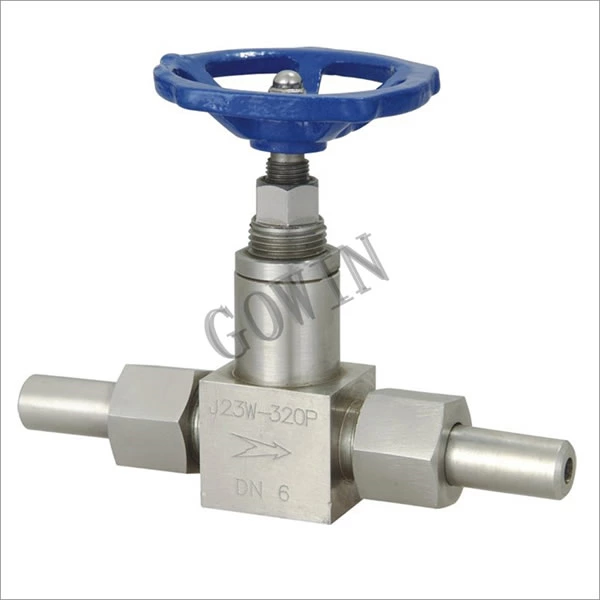
- Diamètre nominal : 1/8″-1″ DN6-DN25
- Pression: 150 lb à 2 500 lb 0,6 Mpa à 42,0 Mpa
- Connexion finale : RF, RTJ, BW, THR, SW
- Température: -196℃-650℃
Conclusion
Start with the duty, then let the duty choose the valve.
If the line needs isolation, choose a ball valve. It closes on a quarter turn, the handle shows the state, the seat wipes itself, and a full-port body keeps the line unrestricted when open. Size it on the pipe, confirm the pressure class, and decide whether manual or actuated operation suits the location. The actuated ball valve installation guide covers the mounting points that matter.
If the line needs fine, repeatable low flow, choose a needle valve. It belongs on sampling lines, bleed lines, gauge protection, metering runs and manifold hookups, where the operator has to set a small flow and hold it. Confirm the size, the pressure class and the temperature, because the needle range is small and the service conditions are often the hard part.
Many instrument hookups use both: a ball valve to isolate the instrument, and a needle valve downstream to bring pressure on slowly or to trim flow. In that arrangement, the ball valve does the shutting off and the needle valve does the adjusting. Neither valve is asked to do the other’s job.
That is the practical answer to the ball valve vs needle valve question. Match the valve to the duty, and put the duty in writing on the RFQ. State the media, the normal and maximum flow, the pressure class, the temperature and the end connection. Add the standard if the project follows one; the API 6D overview explains where that specification applies. The end connection guide covers flanged, threaded and welded choices.
A supplier cannot confirm the right valve from a line item that says “1/2 inch valve” and nothing else. The duty is the specification.
Send service media, size, pressure, temperature and the relevant drawing for a quotation.


 CHINE
 LIBÉRIA
 FRANCE
 BARBADE
 KIRIBATI


