


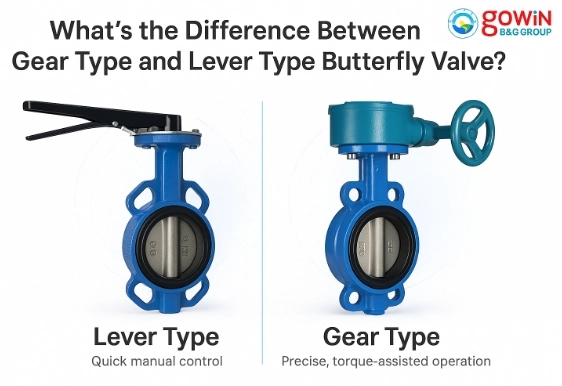
La principale différence réside dans le mécanisme de commande. Les vannes papillon à levier utilisent une poignée pour une commande directe et rapide. Les vannes papillon à engrenages utilisent un réducteur qui multiplie le couple pour un fonctionnement plus lent mais plus contrôlé, nécessitant moins d'effort physique.
Levier ou engrenage : une comparaison rapide
Les deux types flux de contrôle en faisant pivoter un disque de 90 degrés, mais cette méthode crée des caractéristiques de performance distinctes :
| Fonctionnalité | Type de levier | Mécanisme à engrenages |
| Mécanisme | Levier direct relié à la tige de soupape | Réducteur (engrenage à vis sans fin) multiplie le couple |
| Vitesse de fonctionnement | Virage rapide et immédiat à 90 degrés | Plus lent, nécessite plusieurs tours de manivelle |
| Effort physique | Effort important pour les vannes/pressions de grande taille | Faible effort grâce à l'avantage mécanique |
| Gamme de tailles typiques | Jusqu'à DN200 (8 pouces) | DN200 et plus |
| Pression nominale | Faible à modéré | Moyen à élevé |
| Contrôle de précision | Position limitée et difficile à maintenir | Excellente capacité de régulation de la vitesse, tout en douceur |
En quoi les mécanismes diffèrent-ils ?
La vanne à levier papillon est directement reliée à la tige de la vanne. Lorsque vous actionnez le levier, le disque pivote instantanément et proportionnellement au mouvement de votre main. Un mouvement de levier de 90 degrés entraîne une rotation du disque de 90 degrés. Cette liaison mécanique directe permet de transmettre instantanément toute résistance due à la pression du fluide ou au frottement du joint à votre main. L'opération s'effectue en quelques secondes, ce qui rend les vannes à levier idéales pour une isolation rapide.
UN vanne papillon à engrenages Un réducteur est placé entre la manivelle et la tige de la vanne. Le mécanisme d'actionnement d'une vanne papillon utilise généralement une vis sans fin. Ce mécanisme peut avoir un rapport de 40:1 ou 60:1, ce qui signifie que 40 ou 60 tours de manivelle produisent une rotation complète du disque. Ce processus est considérablement plus long qu'une action par levier, mais chaque tour de manivelle produit des changements de position du disque petits et précis, contrairement aux mouvements rapides d'un levier.
Principales différences de performance
Ces différences mécaniques créent trois distinctions majeures en termes de performances, qui déterminent quel type convient à votre application.
Capacité de taille et de pression
vannes à levier : Fonctionne jusqu'à un diamètre DN200 (8 pouces) et des pressions inférieures à 150 PSI. Au-delà, le couple requis dépasse ce que la plupart des opérateurs peuvent appliquer manuellement en toute sécurité. Une vanne papillon type de plaquette La conception à levier fonctionne bien dans les tuyaux de petit diamètre où la surface du disque et les forces de pression restent gérables.
Vannes à engrenages : Prise en charge des diamètres nominaux de 200 à 3000 ou plus, avec des pressions moyennes à élevées. Les dimensions des vannes papillon à engrenages commencent là où la commande par levier devient impraticable. Lors de l'examen dimensions des vannes papillonLes diamètres plus importants sont exclusivement réservés aux opérateurs d'engrenages.
Vitesse contre contrôle
Fonctionnement du levier : Le passage de la position complètement fermée à la position complètement ouverte s'effectue en 2 à 3 secondes d'un simple mouvement. Cette réactivité rend les vannes à levier idéales pour les arrêts d'urgence ou les coupures d'isolement où chaque seconde compte. Cependant, le maintien d'une position intermédiaire est difficile. La connexion directe implique que tout mouvement de la main modifie instantanément la position du disque. Les variations de débit sont brutales, ce qui peut engendrer des surpressions.
Fonctionnement des engrenages : Il faut 30 à 60 tours de volant pour passer de la position fermée à la position ouverte, ce qui est nettement plus long qu'avec un levier. La conception à engrenages de la vanne papillon privilégie la précision à la rapidité. Chaque tour de volant induit une variation faible et prévisible de l'angle du disque. De nombreuses vannes papillon à engrenages sont équipées d'indicateurs de position ou d'échelles graduées indiquant la position exacte du disque. Les opérateurs peuvent ainsi définir des positions précises et y revenir facilement. Le mécanisme à engrenages amortit les mouvements brusques, assurant des réglages de débit fluides et sans à-coups.
Effort opérationnel
Fonctionnement du levier : Il est nécessaire de vaincre directement le couple de manœuvre maximal. Pour les petites vannes dans les systèmes basse pression, cela reste gérable avec une force manuelle normale. Cependant, plus la taille de la vanne ou la pression du système augmente, plus la force requise croît. La manœuvre des grandes vannes ou des vannes à levier haute pression devient alors physiquement exigeante et pose des problèmes de sécurité.
Fonctionnement des engrenages : Le système de commande manuelle par engrenages pour vanne papillon réduit l'effort nécessaire grâce à un mécanisme à démultiplication. Le réducteur multiplie la force appliquée par le rapport de réduction. Une vanne nécessitant un couple de 271 Nm (200 lb-pi) peut ainsi n'exiger qu'une force de 1,5 à 2,5 kg (3 à 5 lb) sur le volant avec un rapport de réduction de 60:1. Une seule personne peut actionner des vannes qui, autrement, nécessiteraient plusieurs opérateurs ou des actionneurs motorisés.

- Diamètre nominal : 8″–104″ (DN200–DN2600)
- Pression: 150LB–300LB (2,5 MPa–5,0 MPa)
- Connexion finale : RF, RTJ, BW, THR, SW
- Température: -196℃–650℃
Quel type choisir ?
Commencez par le diamètre des tuyaux et la pression, ce qui réduit immédiatement vos options.
Choisissez le type de levier pour :
- Diamètres de tuyaux jusqu'à DN200 (8 pouces)
- Systèmes à pression faible à modérée (moins de 150 PSI)
- Applications nécessitant une isolation rapide ou un arrêt d'urgence
- Commande marche/arrêt simple sans besoin de régulation
- Installations à budget maîtrisé où le coût initial est primordial
Choisissez un engrenage actionné pour :
- Diamètres de tuyauterie DN200 et plus
- Systèmes à moyenne et haute pression
- Applications nécessitant un contrôle et un étranglement précis du débit
- Applications à cycle élevé où la réduction de l'effort de l'opérateur prévient la fatigue
- Systèmes où les indicateurs de position garantissent des réglages cohérents et reproductibles
- Installations conformes aux normes industrielles qui spécifient le fonctionnement des engrenages pour certaines tailles
GOWIN fabrique les deux vannes papillon à levier et à engrenage Pour le traitement de l'eau, les applications pétrolières et gazières et la production d'énergie, notre équipe technique évalue vos besoins spécifiques afin de vous recommander le type de vanne optimal. Certifiés API6D et forts de plus de 16 ans d'expérience dans la fabrication, nous proposons des vannes papillon adaptées aux exigences de votre système. Contactez-nous Pour en savoir plus.


 CHINE
CHINE LIBÉRIA
 FRANCE
 BARBADE
 KIRIBATI

