


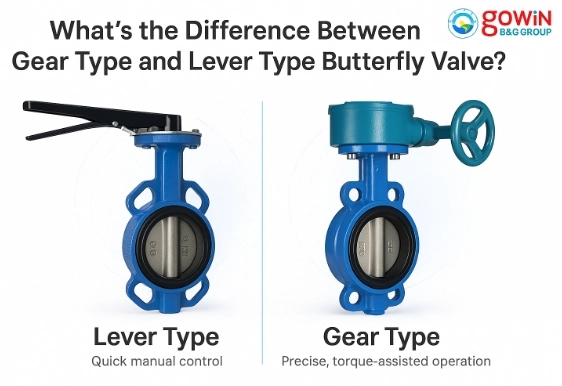
La principal diferencia radica en el mecanismo de control. Las válvulas de mariposa de palanca utilizan una manija para un control directo y rápido. Las válvulas de mariposa accionadas por engranajes utilizan una caja de engranajes que multiplica el par para una operación más lenta, pero más controlada, con menos esfuerzo físico.
Palanca vs. engranaje: una comparación rápida
Ambos tipos flujo de control girando un disco 90 grados, pero el método crea características de rendimiento distintivas:
| Característica | Tipo de palanca | Operado por engranajes |
| Mecanismo | Palanca directa conectada al vástago de la válvula | La caja de cambios (sinfín) multiplica el par |
| Velocidad de operación | Giro rápido e inmediato de 90 grados | Más lento, requiere múltiples giros de manija |
| Esfuerzo físico | Alto esfuerzo para válvulas/presión más grandes | Bajo esfuerzo debido a la ventaja mecánica |
| Rango de tamaño típico | Hasta DN200 (8 pulgadas) | DN200 y mayores |
| Clasificación de presión | Bajo a moderado | Medio a alto |
| Control de precisión | Posición limitada y difícil de mantener | Excelente capacidad de aceleración suave |
En qué se diferencian los mecanismos
La válvula de mariposa de palanca se conecta directamente al vástago de la válvula. Al mover la palanca, el disco gira inmediatamente proporcional al movimiento de la mano. Un movimiento de 90 grados de la palanca genera una rotación de 90 grados del disco. Esta conexión mecánica directa significa que toda la resistencia, ya sea por presión del fluido o fricción del sello, se transfiere directamente a la mano. La operación se completa en segundos, lo que hace que las válvulas de palanca sean ideales para un aislamiento rápido.
A válvula de mariposa accionada por engranajes Coloca una caja de engranajes entre el volante y el vástago de la válvula. El operador de engranajes de una válvula de mariposa suele utilizar un mecanismo de tornillo sin fin. Un operador de engranajes para una válvula de mariposa puede utilizar una relación de 40:1 o 60:1, lo que significa que 40 o 60 vueltas del volante producen una rotación completa del disco. Esto requiere mucho más tiempo que la operación con palanca, pero cada vuelta del volante produce cambios pequeños y precisos en la posición del disco, a diferencia de los movimientos rápidos de la operación con palanca.
Diferencias clave en el rendimiento
Estas diferencias mecánicas crean tres distinciones de rendimiento principales que determinan qué tipo se adapta a su aplicación.
Capacidad de tamaño y presión
Válvulas de palanca: Funciona hasta DN200 (8 pulgadas) de diámetro y presiones inferiores a 150 PSI. Más allá de esto, el par requerido supera lo que la mayoría de los operadores pueden aplicar manualmente con seguridad. Una válvula de mariposa. tipo oblea El diseño operado por palanca funciona bien en tuberías más pequeñas donde el área del disco y las fuerzas de presión permanecen manejables.
Válvulas accionadas por engranajes: Admiten válvulas de DN200 a DN3000 o mayores, con presiones nominales de medias a altas. Las dimensiones de la válvula de mariposa accionada por engranajes comienzan donde la operación con palanca se vuelve impráctica. Al revisar tamaños de válvulas de mariposa, los diámetros mayores especifican exclusivamente operadores de engranajes.
Velocidad vs. Control
Funcionamiento de la palanca: Pasa de completamente cerrado a completamente abierto en 2-3 segundos con un solo movimiento rápido. Esta rápida respuesta hace que los tipos de palanca sean ideales para el cierre o aislamiento de emergencia donde cada segundo cuenta. Sin embargo, mantener una posición intermedia es difícil. La conexión directa significa que cualquier movimiento de la mano cambia inmediatamente la posición del disco. Los cambios de flujo ocurren abruptamente, lo que puede generar picos de presión.
Funcionamiento del engranaje: Requiere de 30 a 60 vueltas del volante para pasar de cerrado a abierto, lo que lleva considerablemente más tiempo que la operación con palanca. El diseño de la válvula de mariposa accionada por engranajes prioriza la precisión sobre la velocidad. Cada vuelta del volante produce un cambio pequeño y predecible en el ángulo del disco. Muchas válvulas de mariposa accionadas por engranajes incluyen indicadores de posición o escalas graduadas que muestran la posición exacta del disco. Los operadores pueden establecer posiciones específicas y volver a ellas constantemente. El mecanismo de engranajes amortigua los movimientos bruscos, proporcionando ajustes de caudal suaves sin picos de presión.
Esfuerzo operativo
Funcionamiento de la palanca: Requiere que se supere directamente el par de operación completo. Para válvulas pequeñas en sistemas de baja presión, esto se puede manejar con una fuerza manual normal. A medida que aumenta el tamaño de la válvula o la presión del sistema, la fuerza requerida aumenta considerablemente. Operar válvulas de palanca grandes o de alta presión se vuelve físicamente exigente y genera problemas de seguridad.
Funcionamiento del engranaje: El operador manual de engranajes para válvulas de mariposa reduce el esfuerzo requerido gracias a la ventaja mecánica. La caja de engranajes multiplica la fuerza de entrada por la relación de transmisión. Una válvula que requiere 200 pies-libra de torque podría requerir solo de 3 a 5 libras de fuerza en el volante con una relación de transmisión de 60:1. Una sola persona puede operar válvulas que, de otro modo, requerirían varios operadores o actuadores eléctricos.

- Diámetro nominal: 8″–104″ (DN200–DN2600)
- Presión: 150 lb–300 lb (2,5 MPa–5,0 MPa)
- Conexión final: RF, RTJ, BW, THR, SW
- Temperatura: -196℃–650℃
¿Qué tipo deberías elegir?
Comience con el tamaño y la presión de la tubería, lo que limitará inmediatamente sus opciones.
Elija el tipo de palanca para:
- Diámetros de tubería hasta DN200 (8 pulgadas)
- Sistemas de presión baja a moderada (menos de 150 PSI)
- Aplicaciones que requieren aislamiento rápido o apagado de emergencia
- Control de encendido y apagado sencillo sin necesidad de limitación
- Instalaciones que se ajustan al presupuesto donde el costo inicial es lo más importante
Elija el engranaje operado para:
- Diámetros de tubería DN200 y mayores
- Sistemas de presión media a alta
- Aplicaciones que requieren control de flujo preciso y estrangulamiento
- Aplicaciones de alto ciclo donde el esfuerzo reducido del operador evita la fatiga
- Sistemas donde los indicadores de posición garantizan configuraciones consistentes y repetibles
- Instalaciones que cumplen con estándares de la industria que especifican el funcionamiento del engranaje para ciertos tamaños
GOWIN fabrica ambos válvulas de mariposa accionadas por palanca y engranaje Para aplicaciones de tratamiento de agua, petróleo y gas, y generación de energía. Nuestro equipo técnico evalúa sus requisitos específicos para recomendar el tipo de válvula óptimo. Con certificación API6D y más de 16 años de experiencia en fabricación, ofrecemos soluciones de válvulas de mariposa que se adaptan a las necesidades de su sistema. Ponte en contacto con nosotros Para saber más.


 PORCELANA
 LIBERIA
 FRANCIA
 BARBADOS
 Kiribati

