


إجابة سريعة
Globe valve flow direction is set by the manufacturer and marked with an arrow on the body. Under-seat flow lets pressure lift the disc and suits low pressure and temperature. Over-seat flow puts pressure above the disc to assist closing and suits high pressure and high temperature. GOWIN lists globe valves from 1/2 to 24 inches, Class 150 to 2500.
Does Flow Go Under the Seat or Over the Seat?

There are two arrangements, and both are normal.
In flow-to-open, also called under-seat or standard flow, fluid enters below the disc. Pressure pushes the disc upward, so the flow helps open the valve. The operator or actuator has to work against that pressure to close it.
In flow-to-close, also called over-seat or reverse flow, fluid enters above the disc. Pressure now pushes the disc toward the seat, so it helps close the valve. The operator has to work against pressure to open it.
Neither arrangement is a mistake. Each is chosen for a reason, and the body is machined and marked for the one it was built to use. The full range is on the globe valve category صفحة.
| Arrangement | Pressure effect | Seating and actuator load | Capacity | Suitable duty |
|---|---|---|---|---|
| Under-seat (flow-to-open) | Pressure below the disc helps open it | Disc self-aligns; the actuator works against pressure to close | Usually the higher Cv arrangement | Low pressure and temperature; general water and utility service |
| Over-seat (flow-to-close) | Pressure above the disc helps close it | Lower closing force; pressure keeps the seat loaded | Some Cv may be lost | High pressure and high temperature; hot lines |
Why Do Most Globe Valves Use Under-Seat Flow?
Under-seat flow is the common default for globe valve flow direction because it solves several problems at once.
The first is seating. With pressure below the disc, the disc is free to align itself as it comes down onto the seat. That self-aligning action helps the disc fit the seat face and reduces the chance of leakage. It also lets the disc rotate slightly on the stem, which spreads wear instead of concentrating it in one spot.
The second is packing life. At low temperature, under-seat flow promotes smooth operation and puts less stress on the packing. That matters on manual valves that are opened and closed often.
The third is erosion. Directing flow under the disc keeps the high-velocity stream away from the seat faces at small openings, which reduces erosive wear on the surfaces that have to seal.
The cost is torque. Because pressure holds the disc against the flow, the actuator needs more force to close the valve than to open it. On a large valve at high differential pressure, that can push the actuator up a size.
Why Choose Over-Seat Flow for High Pressure?
Over-seat flow is the answer when pressure and temperature rise.
The main reason is closing force. With pressure above the disc, the fluid pushes the disc toward the seat. The actuator needs less closing force, and the seat stays loaded even if the stem moves slightly.
The second reason is thermal. In a hot line, a stem that cools after shutdown contracts. On an under-seat valve, that contraction can pull the disc away from the seat and open a leak path. With over-seat flow the pressure keeps the disc against the seat, so contraction does not lift it.
The third reason is flow distribution. At high temperature, over-seat flow spreads the stream across the disc face rather than concentrating it on one area, which reduces local erosion and thermal distortion.
The trade-off is capacity. Reversing the flow through the same body usually costs some Cv, because the internal passages are no longer working with the flow. A valve that was sized on the under-seat Cv may be undersized when built for over-seat flow. That is why the direction and the Cv have to be quoted together.
How Do Large or Actuated Valves Change the Rule?
Size and actuation change the arithmetic, not the principle.
On a large globe valve, the force needed to seat the disc against pressure can become the dominant load. Manufacturers sometimes use a main disc and a smaller vice disc so the valve can be seated in stages. GOWIN lists globe valves from 1/2 to 24 inches with a main and vice disc arrangement at large sizes. That arrangement changes how the valve is stroked, so the flow direction must be confirmed against the actual drawing rather than assumed from a small-size example.
Actuation adds a second constraint. A pneumatic actuator with a spring return has a fixed thrust budget. If the valve is built for under-seat flow and the line runs at high differential pressure, the spring may not produce enough closing force. The result is a valve that will not seat, or an actuator that has to be replaced with a larger one. The أنواع الصمامات الهوائية article explains the common actuator arrangements.
For modulating duty, the trim matters as much as the direction. A control trim shaped for equal-percentage or linear response behaves differently when the flow is reversed. The control valve trim guide covers the main trim types. GOWIN lists a control valve range from 1/2 to 24 inches, Class 150 to 2500, with electric or pneumatic operation and a back seat.
What Does the Body Arrow Tell You?

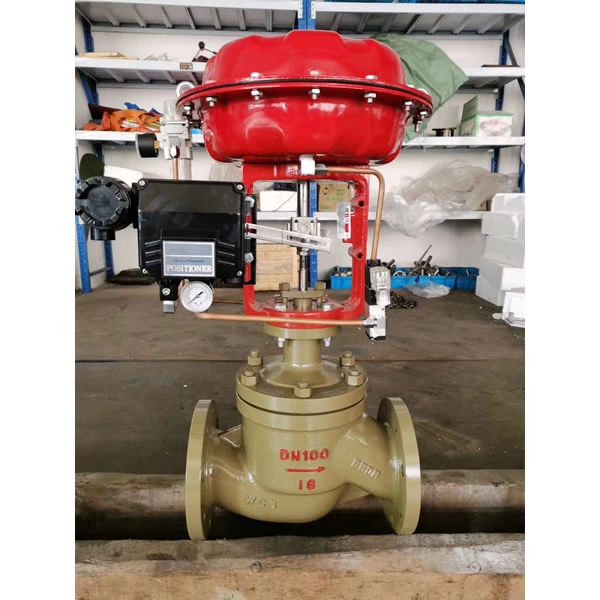
The arrow on the body is the manufacturer’s statement of the globe valve flow direction. It is not decoration, and it is not optional.
Read it before the valve is installed, not after. On a new valve the arrow is cast or stamped on the body, usually near the inlet flange. If the arrow points toward the seat side that receives pressure, the valve is built for under-seat flow. If it points the other way, the valve is built for over-seat flow.
The arrow can conflict with the piping drawing. That happens when a line is reversed during design, or when a valve is bought as a generic “globe valve” without the direction stated. Resolve the conflict before installation. Running a valve backwards can damage the seat, overload the actuator and invalidate the warranty.
At the field level, the arrow is also the quickest way to check a replacement valve against the one being removed. Photograph the old body and the new body side by side, and confirm both arrows point the same way relative to the flow.
How Should Flow Direction Appear in the RFQ?
Put it in writing, on the datasheet, next to the size and pressure class.
Use the terms the supplier uses. “Flow-to-open” and “flow-to-close” are common; “under-seat” and “over-seat” are equally clear. Add the line direction from the piping drawing so there is no ambiguity about which flange is the inlet.
State the duty that drives the choice: normal pressure, maximum differential pressure, operating temperature and whether the valve is manual or actuated. A supplier cannot confirm the arrangement without those numbers. If the valve is for a hot line, say so, because the stem-contraction reason only applies when temperature is part of the duty.
Ask for the Cv or flow coefficient at the quoted direction. A quote that lists one Cv without saying which direction it applies to is incomplete.
Confirm the end connection at the same time, since a change of direction can change the face-to-face dimension on some body patterns. The end connection guide covers flanged, threaded and welded ends.
If the project follows a piping standard, name it. GOWIN lists its globe valve range against BS 1873 and GB/T 12235, with a back seat and a lift of about one quarter of the seat port. The bolted bonnet globe valve guide explains the bonnet construction that goes with that range.
PRODUCT CATEGORY: صمام كروي
STANDARD: ASME، API، JIS، BS، DIN، GB، JB، HG
خاتمة
Start with pressure and temperature, then confirm globe valve flow direction on the drawing.
For low-pressure, low-temperature water, utility and general service, under-seat flow is the usual choice. It seats well, protects the packing and keeps the actuator size reasonable. For high-pressure or high-temperature service, over-seat flow is the usual choice because pressure assists closing and stem contraction cannot lift the disc.
Then check the actuator. If the valve is spring-return pneumatic and the differential pressure is high, confirm the available thrust against the closing force the direction requires. A valve that is correct on paper can still fail to seat if the actuator is undersized.
Then check capacity. If the line is already near its flow limit, the capacity lost by reversing the flow may matter. Compare Cv at the quoted direction, not at a generic rating.
Finally, check the family. A globe valve is the right choice for throttling and frequent operation. For isolation, the gate valve category and the API 600 gate valve are usually cheaper and offer a straighter bore. For quarter-turn isolation, the ball valve category or the floating ball valve is the alternative.
A gate valve should not be used for throttling. The wedge gate throttling note explains why, and the throttling guide compares the valves that are built for it.
Material choice can also settle the question. A high-temperature line may need an alloy body, and a corrosive line may need stainless. The valve material guide covers the main families. For projects that work to API 6D, the API 6D overview explains where that standard applies.
The safe answer is the one on the drawing and the body arrow, confirmed in writing on the quote.
Send service media, size, pressure, temperature and the relevant drawing for a quotation.


 الصين
 ليبيريا
 فرنسا
 بربادوس
 كيريباتي


