


إجابة سريعة
Both valves stop flow, but they carry different penalties. A gate valve lifts clear of a straight bore, giving low pressure loss at full open, but it is tall, heavy and slow to stroke. A butterfly valve is compact and fast, but its disc remains in the flow. Choose by size, space, cycling frequency and shutoff duty; GOWIN supplies both families.
What Is the Real Difference Between a Gate Valve and a Butterfly Valve?
The gate valve vs butterfly valve comparison starts with how the closure member leaves the flow path. A gate valve raises a flat or wedge-shaped gate into a bonnet above the pipe. When the gate is fully open, the bore is almost clear, so the valve behaves like a short piece of pipe. A butterfly valve keeps a disc inside the pipe and rotates it about a stem. Even at full open, the disc and stem remain in the stream.
That single difference explains most of the trade-offs. The gate needs a tall bonnet to park the gate, so the valve is tall and heavy, especially in large sizes. The butterfly needs only the disc and a short body, so it is compact and light. The gate takes many turns to stroke; the butterfly takes a quarter turn.

It also explains the pressure-loss pattern. A fully open gate valve has a low loss coefficient. A fully open butterfly valve still has the disc thickness and the stem in the flow, so its loss is higher, though usually modest at full open. At part open, the butterfly becomes a useful throttling device and the gate becomes a wear problem. That is why the wedge gate throttling analysis treats partial gate opening as a maintenance issue rather than a control method.
| Buyer criterion | Gate valve | Butterfly valve | What to confirm |
|---|---|---|---|
| Flow path at full open | Nearly clear bore; low resistance | Disc and stem remain in the flow | Acceptable pressure loss at duty flow |
| Size and installed envelope | Tall bonnet; weight rises quickly in large sizes | Short face-to-face and lower weight | Available headroom and support steel |
| Operating speed | Many turns; slower stroke | Quarter-turn; easy to automate | Cycling frequency and actuator air supply |
| Shutoff | Robust metal-seated options for demanding isolation | Resilient or metal seat depending on design and class | Required leakage class and seat material |
| Temperature and pressure | Wider range with suitable body and trim | More limited by seat and body design | Catalogue limit for the exact model |
| Best fit | Long-term isolation, high energy sensitivity and demanding service | Large lines, tight space and frequent operation | The duty, not the purchase price alone |
Why Does a Gate Valve Use Less Energy When Fully Open?
A gate valve that is fully open presents a straight, full-bore path. The fluid does not have to turn, squeeze past a disc or cross a seat. The pressure loss is small, so the pump does not have to make up for a permanent restriction. On a line that runs for years, that saving is continuous.
The catch is that the saving only applies when the valve is fully open. A gate valve left partly open is in the worst position: the gate edge sits in the flow, the seat is exposed to velocity and debris, and the disc can vibrate. The valve may still pass fluid, but it is no longer doing the job it was designed for.
GOWIN lists its API 600 gate valve for on/off service, with a back seat, graphite stem sealing, sizes from 1 inch to 42 inches, Class 150 to 2500, and a temperature range of -29 to 560 C. Those figures describe the catalogue range, not a guarantee that every combination suits every line. The point for the buyer is that this is a heavy-duty isolation family, not a control valve with a gate-shaped body.
If the duty is throttling, the throttling guide sets out the alternatives. A globe or control valve is built to regulate. A gate valve is built to be either open or closed.
A certain angle is formed between the two sealing faces of the single-disc or double-discs wedge gate valve and perpendicular to the pipeline axis.
عرض تفاصيل المنتج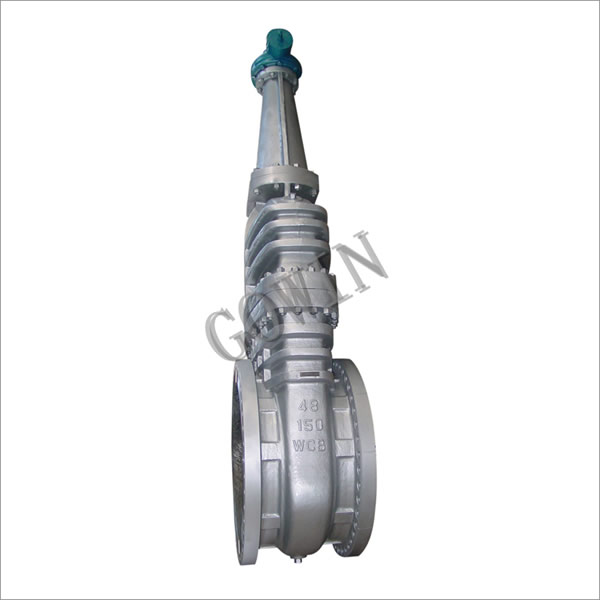
When Is a Butterfly Valve the Better Choice for Isolation?
A butterfly valve wins when the line is large, the space is tight, and the valve will be operated often enough that a quarter-turn stroke matters. Its body is short, its weight is lower, and a gear or actuator can be mounted without a tall bonnet. On a large water line, that difference in installed envelope can decide the layout.
It also wins when isolation does not have to be perfect in both directions. A resilient-seated butterfly valve depends on the disc pressing into a rubber or elastomer liner. That design gives good shutoff in general service, but the liner is a wear item and the temperature ceiling is lower than a metal-seated gate. GOWIN lists its wafer butterfly valve from 2 to 120 inches, Class 150 to 600, -46 to 200 C, with carbon, stainless and alloy bodies and manual, worm gear or electric operation.
The wafer body is the common choice because it fits between two flanges and takes little pipe length. The trade-off is that the wafer valve relies on the flange bolts to hold it in place, so the mating flanges and gasket details matter. The lug versus wafer comparison explains when a lug body is worth the extra metal: a lug valve can be bolted on one side and still hold line pressure, which helps when one side of the line has to be opened for maintenance.
For on/off service with frequent cycling, a pneumatic butterfly valve is a practical package. The quarter-turn stroke is short, the actuator is small, and the valve can be set to fail open or fail closed. The same duty on a gate valve needs a much larger actuator and a longer stroke.
معيار التصميم وفقًا لـ: API 609، ASME B16.34، GB/T12238، JB/T 8527.
عرض تفاصيل المنتج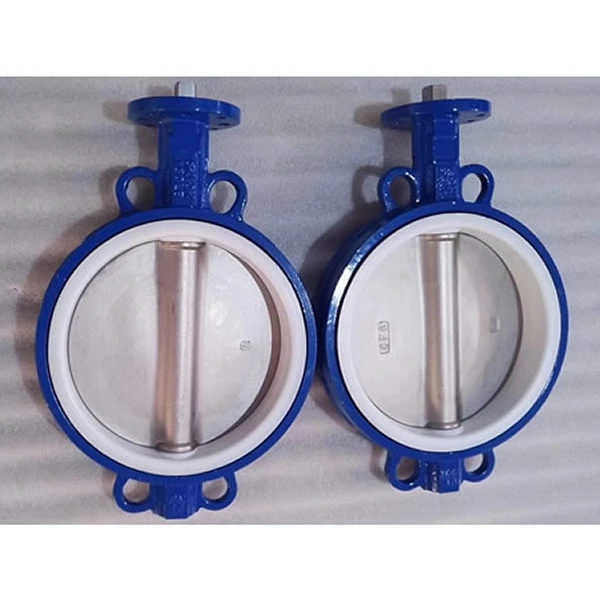
Where Does a Gate Valve Still Win?
The gate valve wins on tightness, pressure capability and tolerance of dirty service. A metal-seated gate can hold a hard seat against high pressure and temperature, and the straight bore lets pigs and cleaning tools pass. It is the default for isolation on steam, high-pressure water and many hydrocarbon lines.
It also wins when the valve is normally open and rarely moved. The slow stroke is not a disadvantage if the valve is opened at commissioning and closed for maintenance. The tall bonnet is not a problem if the line has headroom. In that duty, the lower running loss and the robust seat do more for the owner than the butterfly valve’s compact body.
The gate valve’s weakness is its stem and bonnet area. The stem passes through packing, and the bonnet joint is a potential leak path. GOWIN describes a back seat on its gate and globe ranges; that feature allows packing replacement to be planned with the stem in the back-seated position, but it does not remove the need to follow the manual and the site procedure. A buyer should treat the back seat as a maintenance feature to confirm, not as a licence to repack a live valve.
The gate valve category shows the family range. If the line also needs quarter-turn operation at high pressure, the gate versus ball comparison explains where a ball valve takes over.
How Do Size, Weight and Space Change the Decision?
In a gate valve vs butterfly valve comparison, size changes the answer faster than any other variable. At small sizes, the two valves can be close in cost and envelope, and the choice comes down to the duty. At large sizes, the gate valve’s bonnet and body grow into a heavy casting that needs its own support, while the butterfly valve stays relatively light and short.
Weight is not just a freight line. It affects lifting, support steel, flange loads and the number of people needed for maintenance. A 30-inch gate valve is a crane item. A 30-inch wafer butterfly valve can often be handled with rigging that is already on site. That difference shows up in the installation method statement before it shows up in the valve price.
Space works the same way. A gate valve needs vertical clearance for the rising stem and the bonnet. A butterfly valve needs clearance for the actuator and, on some bodies, room to rotate the disc. If the line is buried or stacked, the gate’s stem height may rule it out. If the line is in a plant room with limited headroom, the butterfly valve may be the only practical option.
Temperature and pressure narrow the field again. GOWIN’s wafer butterfly range goes to Class 600 and 200 C; the API 600 gate range goes to Class 2500 and 560 C. Those are catalogue ceilings, and the actual limit depends on body material, seat material and trim. A buyer should never assume the top of the range applies to the standard build.
What Should the RFQ Say to Make Two Offers Comparable?
For a gate valve vs butterfly valve RFQ, start with the duty, not the valve name. State whether the valve is for isolation, throttling, or both, and how often it will be cycled. Then give the line data: size, pressure class, design code, fluid, design temperature, and the required shutoff class.
Add the details that change the price:
- Body, disc or gate, stem and seat materials, with any NACE, low-temperature or fire-safe requirement.
- End connections and the mating flange standard. The end connection guide covers the common choices.
- Face-to-face or wafer length, and the available envelope.
- Operation: lever, gear, pneumatic or electric, with fail position and any solenoid or limit switch requirement.
- Test scope: shell, seat, backseat where applicable, and whether the buyer will witness.
- Documentation: approved drawing, bill of materials, test report, installation manual and spare parts list.
- Tagging, painting, packing and destination.
Two questions separate a real offer from a catalogue reference. Ask whether the quoted seat and body materials are the ones in the drawing, and ask what spare parts the supplier recommends for the first two years. The valve materials guide helps the buyer read the answer.
If the valve is automated, add the actuator data sheet. The pneumatic valve overview explains the common arrangements. GOWIN lists manual, worm gear and electric operation for the wafer butterfly range, and the product drawing shows the actuator interface.
خاتمة
Choose the gate valve when the duty is isolation, the line is small enough that the bonnet is not a problem, the pressure or temperature is high, and the valve will sit open or closed for long periods. Choose the butterfly valve when the line is large, the space is tight, the valve will be cycled often, and the service is within the seat’s temperature and chemical limits.
The short answer to the gate valve vs butterfly valve question is that neither is a general replacement for the other. The gate buys a clear bore and a robust seat with height, weight and a slow stroke. The butterfly buys a short body and a fast stroke with a disc in the flow and a seat that sees the fluid. Match the penalty to the line.
If the duty is quarter-turn isolation at high pressure, look at the 2 PCS ball valve and the ball valve category. If the line needs a metal-seated butterfly for higher temperature, the triple eccentric explainer explains what the third offset changes. For a wider view of the family, the butterfly valve category lists the body and connection options.
Send service media, size, pressure, temperature and the relevant drawing for a quotation.


 الصين
 ليبيريا
 فرنسا
 بربادوس
 كيريباتي


